OMG, this is too hilarious!!!! Another weekly video from Horrible Histories on Georgian court toilets :)
Tuesday, December 4, 2012


Monday, December 3, 2012
Highland Rake with a Ghostly Twist by Terry Spear

Highland Rake with a Ghostly Twist
FromRavenswood House in Ballater, Aberdeenshire where a seafaring ghost, trader in
alcohol and tea, resides…to ghostsat various inns all over Scotland…to a BBCspecial about how highly populated Scotland is with ghosties…to castles
that house ghosts…

Dunnottar Castle

and Brodie Castle
I was
fascinated with the idea of incorporating one…or a few…in my current book
release.
In one
castle we visited, it was said that a young lady was taken in by the laird, but
when she was found pregnant, and unwed, she vanished. Now her ghost haunts the
castle.
We didn’t
see any evidence of hauntings while we visited the seven castles in Scotland,
but when we stopped to take pictures of the Highland cows in a pasture, trees
shading them, no farmhouse nearby, a river beyond the field, tall hills behind
us, no buildings or people anywhere about, I heard the most beautiful
instrumental Celtic music. I felt carried away to a movie scene, the grass
bright green, the air chilly on that October day, the red long-haired cows
munching on grass, and the Celtic music playing in the background.
When I
reached the fence to get as close as I could to take pictures of the cows, the
music stopped. I took several pictures, then joined my lady friends, one being
Vonda Sinclair, another Highland romance writer, and said, “Did you hear the
music? Wasn’t it beautiful?”
 |
| Highland Cow |
I knew
they’d say yes. I mean, who wouldn’t who loved all things Scottish?
Neither
heard any music. I couldn’t believe it. It was real, just beyond the tall
lonely hills where not a soul lived or stirred.
So when I
wrote Highland Rake, third book in
The Highlanders series, I wanted the heroine to be able to commune with ghosts.
She has a pesky ghostly brother, and the hero’s spirited sister that tangles
with Alana’s brother. The story is filled with mystery—why her brother had
died, who had murdered her father and his men—and both the living and the dead
help to provide clues in this Highland Medieval romance.
Even in my
Highland wolf series, starting with Heart
of the Highland Wolf, the MacNeills have a ghostly cousin who lives at
Argent Castle. I just couldn’t write the werewolf tale, without having a
resident ghost! In A Howl for a
Highlander, and A Highland Werewolf
Wedding, both coming in 2013, the MacNeill ghost has his part. The Castle
Dunnottar inspired me to write: A
Highland Werewolf Wedding though. The Medieval castle overlooks the
northeast coast of Scotland in Kincardineshire and was extremely cold
that day. But when we were in the inner bailey, surrounded by thick walls, I
felt almost warm. I didn’t feel anything evil—just at home there. And so
because of that I used the castle ruins in the story.
Several
roads in Scotland have ghostly sightings also. Drivers have thought they’ve hit
a person, only to discover there is no one there. One of the days we traveled,
the fog was so thick, it was hard to see much of anything. I could imagine a
ghost blending in with the mist.
Scotland
just seems the perfect place for spirits to thrive.
Having had
a love of all things ghostly since I was a child, but never having experienced
such a thing back then, I always felt the ghost stories fun-filled fantasy. I
later encountered ghostly apparitions. One was in the Palo Duro Canyon, Texas,
where Indian ponies raced across the cliffs, and as I was curled up in a
sleeping bag alongside my fellow Army ROTC cadets, I believed we would be
trampled to death. Except the ponies were already dead—corralled by the US
Cavalry and herded off the cliff’s edge to prevent the Indian tribes that had
gathered to fight from remounting their ponies and fighting again.
I didn’t
believe that I had had a ghostly experience then. I never do. It happened. I
heard them, their hooves pounding the ground, their neighing and whinnying, and
snorts. The only thing I realized I didn’t sense was the vibration through the
ground that I would have felt as they stampeded toward us. They moved away and
faded into the night. And no one but me had heard them.
Yet, when I
went to write about the real ponies years later, and was doing research about
them, for years believing they were wild mustangs, I discovered many over the
years had heard the ghostly horses.
I’ve had
other experiences too, only in one, my son, daughter, and mother witnessed it
too. You know, it’s really great when others have seen or heard the same thing
you have!
So what
about you? Ready to witness ghosts in Scotland? Or have you already? Or
somewhere else that you’ve been?

Dougald MacNeill takes
Lady Alana Cameron to his laird brother James's Craigly Castle when he finds
her roaming the heather on the MacNeill lands. But who has sent her there and
why? Her uncle, laird of the Cameron clan, and warring with the MacNeill for
years, has made a marriage arrangement with another clan and now that is even
at stake.
Having witnessed her
father's death, and even believing he had returned her home when all along he
had been dead, Alana discovers she has the gift, or curse, of seeing the newly
departed and sometimes those who should have long ago passed over. Her own
deceased brother continues to plague her, the rake, and now another, who
is very much of the flesh, Dougald MacNeill, has her thinking marrying a rake
might just have its benefits. Dougald's sister, who is one fiesty ghost, has
offered to help Alana keep Dougald in line if he thinks of even straying.
But who sent Alana
on a fool's errand in the first place to remove her from the Cameron's lands
and set her squarely in Dougald's care, and who really killed her father and
her brother, and what has it all to do with Alana? Will she and Dougald learn
the truth before it is too late?
Terry
"Giving new meaning to the term alpha male where fantasy IS reality."
About the Author
USA Today
bestselling and an award-winning author of urban fantasy and medieval romantic
suspense, Terry Spear also writes true stories for adult and young adult
audiences. She’s a retired lieutenant colonel in the U.S. Army Reserves and has
an MBA from Monmouth University. She also creates award-winning teddy bears,
Wilde & Woolly Bears, that are personalized that have found homes all over
the world. When she’s not writing or making bears, she’s teaching online
writing courses or gardening. Her family has roots in the Highlands of Scotland
where her love of all things Scottish came into being. Originally from
California, she’s lived in eight states and now resides in the heart of Texas.
She is the author of the Heart of
the Wolf series and the Heart of the Jaguar series, plus numerous other
paranormal romance and historical romance novels. For more information, please
visit www.terryspear.com, or follow her on Twitter, @TerrySpear. She is also on Facebook at http://www.facebook.com/terry.spear .
Saturday, December 1, 2012
Christmas on the Home Front in 1939 by Fenella Miller
Today I'd like to welcome guest author, Fenella Miller, to History Undressed! She's written a post on Christmas on the home front for us! Enjoy!


Christmas on the Home Front in 1939
by Fenella Miller
 |
| Photo by Phil Gyfford, courtesy of Flickr |
1939
was the last of what could be thought of as a ‘pre-war’ Christmas. Although
there were restrictions and the blackout was in place civilians were determined
to celebrate. An advert that ran sums up
what people felt, “As dusk falls, the fairy lights on the Christmas tree
outside St Paul’s Cathedral will go out… we must await victory to again see
them at night in all their colours.”
Amazingly
over 4000 civilians were killed on the
roads that winter compared to 2500 the previous period in 1938. There were 155
lives lost in accidents on the road in December of 1939 –the highest recorded
number of deaths.
The
weather that year was very seasonal – most of the country was blanketed in
snow. In fact this was the coldest winter for nearly fifty years. Families were
without their sons, fathers and brothers and over half a million men were
serving in France.
The
government wanted the population to know what they were fighting for –
celebrating as always would reinforce this message. The radio, magazines and
newspapers all stressed the importance of community spirit, family values,
neighbourliness, faith and tradition. They wanted families to celebrate in
style. Rationing didn’t begin until January so there was no shortage of the
traditional Christmas fare. No doubt many remembered the shortages experienced
in WW1 and were already hording food in the expectation that things would be in
short supply very soon.
Children’s
toys were still available but even in 1939 suggestions were being made for ways
civilians could ‘make do and mend’. Rubber toys for the bath could be made from
old inner tubes or hot water bottles. These are cut with scissors and stuck
together with the rubber solution used to end a puncture. They were then packed
with kapok or chopped up bits of rubber or cork sawdust from fruit packing.
These don’t sound especially attractive – I can’t imagine any five year old
being thrilled to find a dingy grey rubber toy in their sock on Christmas
morning. Card games called ‘Vacuation’ and ‘Blackout’ were also popular. My
husband remembers being delighted to have an orange, nuts, a sugar mouse and a
couple of wooden farm animals in his sock. For him, a rural working class
family, presents under the tree didn’t feature.
Folk
were asked to send parcels to the troops in France containing men’s magazines
and darts. A personalised Christmas card was also added – the cost was only 3s
6d. Women’s Pictorial suggested families sent boiled sweets, jam, biscuits,
chutney, plum cake as well as soap and razor blades.
Nothing
much has changed even after almost seventy years. I was sending parcels to out
brave troops in Afghanistan last year with more or less the same things in –
minus the darts and razor blades. Nothing sharp is allowed in BFPO parcels.
Christmas
day radio broadcast would have been an important part of the festivities –
although church would have come first. Her is small selection of what would
have been listend to:
7.00: Christmas Greetings – a sackful of stories,
verses and records.
7.40: The Reginald King Trio
8.15: Christmas Carols
…
10.00: A Nativity play by Bernard Walker ‘Bethlehem’
…
1.10: An Orchestral Concert conducted by Guy Warrack.
…
2.15:
The Empire’s Greeting. (This involved
messages form navy vessels, an airborne RAF aircraft, a Welsh miners’ choir, a
shipyard worker’s house in Northern Ireland and many other similar things
3.00
The King’s Speech ).
I
doubt anyone stands to attention when the Queen addresses the nation nowadays.
Hope
you enjoyed this brief glimpse into Christmas in 1939.
Fenella
J Miller
As war rages over Europe, Barbara Sinclair
is desperate to escape from her unhappy home which is a target of the German
Luftwaffe. Caught up by the emotion of the moment she agrees to marry John, her
childhood friend, who is leaving to join the RAF, but a meeting with Simon
Farley, the son of a local industrialist, and an encounter with Alex Everton, a
Spitfire pilot, complicate matters. With rationing, bombing and the constant
threat of death all around her, Barbara must unravel the complexities of her
home life and the difficulties of her emotional relationships in this gripping
coming-of-age wartime drama.
World War II brings divided loyalties and
tough decisions in this page turning drama from Fenella Miller.
Hannah Austen-Bagshaw’s privileged
background can’t stop her falling in love with working-class pilot, Jack, but
Hannah has a secret. Torn between her duty and her humanity, she is sheltering
a young German pilot knowing she risks being arrested as a traitor. Hannah’s
worst fears are realised when Jack finds out what she has done and their love
begins to unravel.
Will her betrayal be too much for Jack to
forgive?
Thursday, November 29, 2012
Cerne Abbas Giant...aka The Giant Penis Man

The other night the DH and I were surfing through popular shows on Hulu, when we came across Kim Cattrell's Sexual Intelligence. Never one to pass up on an opportunity to learn about the human body, I selected it (alas, I did not finish it...got too tired). I was pleasantly surprised when she stood on the 8-foot-long phallus of this giant--how in all of mankind had I missed this??? Have you heard of it?
It is a monument in England, seriously!!
According to the National Trust site, the figure is believed to be Hercules carrying a club...and wearing one too it seems, lol.

The fact of the matter is--in Dorset England, there is a huge chalk figure with a thoroughly engorged penis, and I have just added it to my list of things I must see!
If you care to visit the site, here's a link.
Wednesday, November 28, 2012
Christmas in Medieval Times by Dana D’Angelo
Today I'd like to welcome guest author, Dana D'Angelo to History Undressed! She's got a special medieval Christmas treat for us :)

Christmas in Medieval Times by Dana D’Angelo
The term “Christes Maesse” was first introduced in a Saxon
book in 1038 AD.
One source I found claimed that Christmas gradually became
popular by a succession of rulers such as Charlemagne (800 AD), Edmund the
Martyr (855 AD), and William I of England (1066 AD) who chose
Christmas Day to become crowned.
Another source suggested that the Church didn’t have a fixed
date for Christmas Day until the 4th century. And they chose
December 25th in an attempt to superimpose on a pagan holiday that
fell on the same date.
But whatever the case may be, there is no denying that the
Druid or pagan traditions integrated with the Christian ones to form new ideas
about celebrating and feasting during the holidays.
Over a twelve day span, the merging of these two customs
allowed people to indulge in food and “misrule” (drunkenness, promiscuity and
gambling), which was a large part of the pagan celebrations. At the same time,
these same people were able to commemorate the birth of Christ and their own
salvation.
By the time the High Middle Ages rolled around, Christmas
became so wide spread that that writers of the time noted how influential
people celebrated the holiday. In 1377 AD, for instance, King Richard II of England hosted
a Christmas banquet that served twenty-eight oxen and three hundred sheep!
In terms of gift giving, this act was usually done between
people with a legal relationship such as a tenant and landlord. While it was
customary for noblemen to give tenants and workers time off to celebrate the
“holy days”, it wasn’t customary for them to give gifts. However if a landlord
decided to show his generosity, he may have offered coins to servants and
apprentices, or treated the poor to a supper in the great hall.
However whether the people were poor or wealthy, they
appreciated the holiday fare. Throughout the year, they were constantly hungry
and the holidays were the only times that they could indulge in food.
Some popular foods and drinks the people enjoyed were:
- Wassail – A powerful, hot drink that was made from a mixture of ale, honey and spices. The host served the drink from a large bowl. With friends present, he would cheerfully call out “waes hael” or “be well.” The friends, meanwhile, would reply with “drink hael” or “drink and be well.”
- Baked Mince Pie – Minced pie was baked in an oblong shape to symbolize the crib that Jesus slept in. It consisted of shredded meat, fruit, and three spices (cinnamon, cloves and nutmeg) to represent the three gifts offered to Christ from the Magi. The people held a belief that a wish made on the first bite of the pie caused the wish to come true. However if a person refused that important first bite during Christmas, bad luck would follow him in the new year.
- Pudding or Frumenty - Essentially a spicy porridge made from boiled wheat, currants, dried fruit, yolks and spices such as cinnamon or nutmeg. The mixture was cooled and then allowed to set before it was served.
- Golden Roasts - In noble homes, the cooks strived for artistry in their culinary creations. For example, to make a roasted peacock look visually appealing, they would add butter and saffron to paint the meat in a golden hue. When the peacock was finished cooking, they often redressed the gilded bird in its old skin and feathers.
- Boar’s Head - A boar’s head, with an apple or an orange in its mouth, was placed at the trestle table during an extravagant banquet. This rosemary and bay scented center piece was considered a noble dish and eagerly enjoyed by dinner guests.
All in all, the history of Christmas during the Middle Ages
was an interesting one. While it seemed that new traditions emerged, they were
in fact heavily grounded by the old ones.
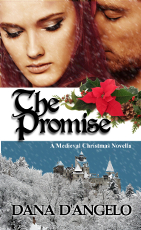
The Promise - A
Medieval Christmas Novella
Sir Gavin the Bold appears one winter evening demanding
payment for saving the life of Baron Clifton de Leraye. The knight claims that
he is entitled to marry one of the lord’s three daughters.
Except the claim is called into question.
With the family’s honor at stake, and her sisters’ futures
on the line, Lady Estella de Leraye does all she can to protect what little
integrity the family has left, even if that means agreeing to marry the dark
stranger.
As she struggles to come to terms with her plight, she finds
it equally difficult to fight her growing attraction to the handsome knight.
But will his charm and allure prepare her for the secret she will soon
discover?
Note: This medieval
Christmas romance novella is approximately 29,000 words or about 80 print
pages. Although the story has romantic elements, it does not contain explicit
love scenes.
Tuesday, November 27, 2012
Video of the Week: Horrible Histories -- Spartan Shield
This week's video is from Horrible Histories -- the Spartan Shield!
Funny! Enjoy!
Thursday, November 22, 2012
History Channel's -- History of Thanksgiving
From all of us at History Undressed, we wish all those in the US a Happy Thanksgiving!
Subscribe to:
Posts (Atom)