Above painting: Louis Jean Francois - Mars and Venus an Allegory of Peace

Pages

***All photos accompanying posts are either owned by the author of said post or are in the public domain -- NOT the property of History Undressed. If you'd like to obtain permission to use a picture from a post, please contact the author of the post.***
Showing posts with label Dana D'Angelo. Show all posts

Wednesday, November 28, 2012

Christmas in Medieval Times by Dana D’Angelo


Today I'd like to welcome guest author, Dana D'Angelo to History Undressed! She's got a special medieval Christmas treat for us :) 

Christmas in Medieval Times by Dana D’Angelo


The term “Christes Maesse” was first introduced in a Saxon book in 1038 AD.

One source I found claimed that Christmas gradually became popular by a succession of rulers such as Charlemagne (800 AD), Edmund the Martyr (855 AD), and William I of England (1066 AD) who chose Christmas Day to become crowned.

Another source suggested that the Church didn’t have a fixed date for Christmas Day until the 4th century. And they chose December 25th in an attempt to superimpose on a pagan holiday that fell on the same date.

But whatever the case may be, there is no denying that the Druid or pagan traditions integrated with the Christian ones to form new ideas about celebrating and feasting during the holidays.

Over a twelve day span, the merging of these two customs allowed people to indulge in food and “misrule” (drunkenness, promiscuity and gambling), which was a large part of the pagan celebrations. At the same time, these same people were able to commemorate the birth of Christ and their own salvation.

By the time the High Middle Ages rolled around, Christmas became so wide spread that that writers of the time noted how influential people celebrated the holiday. In 1377 AD, for instance, King Richard II of England hosted a Christmas banquet that served twenty-eight oxen and three hundred sheep!

In terms of gift giving, this act was usually done between people with a legal relationship such as a tenant and landlord. While it was customary for noblemen to give tenants and workers time off to celebrate the “holy days”, it wasn’t customary for them to give gifts. However if a landlord decided to show his generosity, he may have offered coins to servants and apprentices, or treated the poor to a supper in the great hall.

However whether the people were poor or wealthy, they appreciated the holiday fare. Throughout the year, they were constantly hungry and the holidays were the only times that they could indulge in food.

Some popular foods and drinks the people enjoyed were:


  • Wassail – A powerful, hot drink that was made from a mixture of ale, honey and spices. The host served the drink from a large bowl. With friends present, he would cheerfully call out “waes hael” or “be well.” The friends, meanwhile, would reply with “drink hael” or “drink and be well.”
  • Baked Mince Pie – Minced pie was baked in an oblong shape to symbolize the crib that Jesus slept in. It consisted of shredded meat, fruit, and three spices (cinnamon, cloves and nutmeg) to represent the three gifts offered to Christ from the Magi. The people held a belief that a wish made on the first bite of the pie caused the wish to come true. However if a person refused that important first bite during Christmas, bad luck would follow him in the new year.
  • Pudding or Frumenty - Essentially a spicy porridge made from boiled wheat, currants, dried fruit, yolks and spices such as cinnamon or nutmeg. The mixture was cooled and then allowed to set before it was served.
  • Golden Roasts - In noble homes, the cooks strived for artistry in their culinary creations. For example, to make a roasted peacock look visually appealing, they would add butter and saffron to paint the meat in a golden hue. When the peacock was finished cooking, they often redressed the gilded bird in its old skin and feathers.
  • Boar’s Head - A boar’s head, with an apple or an orange in its mouth, was placed at the trestle table during an extravagant banquet. This rosemary and bay scented center piece was considered a noble dish and eagerly enjoyed by dinner guests.

All in all, the history of Christmas during the Middle Ages was an interesting one. While it seemed that new traditions emerged, they were in fact heavily grounded by the old ones.

The Promise - A Medieval Christmas Novella

Sir Gavin the Bold appears one winter evening demanding payment for saving the life of Baron Clifton de Leraye. The knight claims that he is entitled to marry one of the lord’s three daughters.

Except the claim is called into question.

With the family’s honor at stake, and her sisters’ futures on the line, Lady Estella de Leraye does all she can to protect what little integrity the family has left, even if that means agreeing to marry the dark stranger.

As she struggles to come to terms with her plight, she finds it equally difficult to fight her growing attraction to the handsome knight. But will his charm and allure prepare her for the secret she will soon discover?

Note: This medieval Christmas romance novella is approximately 29,000 words or about 80 print pages. Although the story has romantic elements, it does not contain explicit love scenes.


Friday, November 16, 2012

Historical Romance Review: One True Knight by Dana D’Angelo

This book has been reviewed by History Undressed reviewer, Morgan Wyatt...

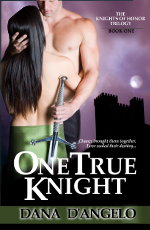
ABOUT THE BOOK...


When the beautiful yet feisty Rowena de Belleville discovers her father’s plan to remarry, she fears the worst and flees her home — only to be thrust into the arms of a stranger.

Desperate to hide her identity from her pursuers, she embraces the dark stranger. But her reckless act backfires as it awakens a passion buried deep within her soul, while igniting the fuse of her mysterious benefactor.

Unable to escape destiny, their paths cross yet again. This time she learns the handsome man is Jonathan d’Abelard - the Iron Hawk, a legendary knight feared by all save one faceless killer bent on making his life a living hell…

Will her chance encounter draw them together, or ensnare her in a dangerous game of seduction, feverish desire and vengeance?


MORGAN'S REVIEW...


One True Knight by Dana D’Angelo is a medieval romance that highlights the differences in the freedoms enjoyed by men and women of the period. Rowena’s ability to be her own woman, and manage the castle grind to an unexpected halt when her father, Sir Phillip’s announcement that he will marry. Ten years ago, when his beloved wife died he swore to never remarry. He also chose to ignore Rowena because he blamed her for the plague her mother contacted from nursing her. Her impulsive nature forces her into action.

Jonathan is more than a wandering knight he is a man on a mission. His first mission is vengeance against the Grey Knight. The nefarious knight is so bold to send him messages and taunts causing Jonathan to scurry across the country in search of the knight. His cousin has asked him to vet Sit Phillip before she marries. His cousin a widow finds herself forced to choose between her two neighbors to be able to afford some type of protection for her people.

Rowena escapes the castle disguises as a simple servant. She isn’t quite sure of her plans, but she realizes a new mistress will change her role in the house, and maybe even push her out of it. Jonathan disguises himself as a peasant too in an effort to find out more about Sir Phillip. In an effort to escape her father’s guards, she chooses to kiss Jonathan as a distraction, sparking an attraction between the two of them. She flees refusing even to leave a name with the besotted knight.

One True Knight has a great deal going on, besides romance including intrigue and betrayal. There is also the double disguise of Jonathan and Rowena pretending to be other people, always a handy plot device. The chemistry between the two works well. The characterization of the cousin being a pawn in the games of men is accurate for the period. This is a good debut novel, but there are areas where it could be stronger.

More detail would give me a sense of being there. Historical references were rather vague, specific ones as a tie-in could help in getting a feel for the period, and the people.  In the beginning, Rowena acts more like a spoiled brat caring more about herself, than anyone else. She doesn’t care about her father’s happiness; she’s just upset because his marriage might mess her life up. She sets up her own nursemaid to get in trouble so she can run the country in disguise. Rowena improves as the book goes on maturing with the chapters.
One True Knight is a good bet for medieval romance fans. Its short length makes it a quick read too.

Monday, October 1, 2012

The Truth Behind Knights in Shining Armor by Dana D’Angelo

Welcome to History Undressed, today's guest blogger, Dana D'Angelo, author of medieval romance. She's here to talk with us about the truth behind knights in shining armor! Enjoy!


The Truth Behind Knights in Shining Armor 

by Dana D’Angelo


What is it about knights that capture our imagination? Is it that they’re true heroes, intent on protecting the less fortunate, fighting bravely and fiercely for their home and country? Is it their admiration for and love of women? This is what Hollywood wants us to believe.

But if you look closely, there are actually grains of truth in this portrayal.

You see, a seven year old boy, usually from a well off family, would be sent to foster at another home and be trained as a knight. At first he would act as a page, essentially becoming a servant, and heeding his master’s every beck and call. He would start at this humble beginning until he reached the age of about 14 years. At this point, he would graduate to become a squire. He would gain enough confidence from his master to accompany him into battle, although he didn't exactly participate in the fighting.

In his long years of training to become a knight, the squire would learn all sorts of things including battle readiness and the finer arts of socialization. Geoffrey Chaucer, a well known writer in the middle ages, illustrated in one of his characters a squire that had the ability to compose songs, dance, draw, and write. On top of everything, this character had horse riding expertise and proficiency in jousting.

Although Chaucer’s character is obviously fictional, we can assume that these abilities were quite common at the time. Scholars believe that during the early medieval period, warriors acted upon an unspoken rule where they behaved in a courteous and civil manner when dealing with their enemies. As time went on, this behavior gained favor with many people and a knightly code of conduct was formed.

Poems of courtly love were recited throughout the land by troubadours, and the ideals of chivalry were spread. It was around the 13th century that romance stories such as the legendary tales of King Arthur and his Knights of the Round Table became extremely popular. It’s debatable whether King Arthur really existed, however these stories further influenced the way a knight behaved toward their enemies and those of a more gentle birth.

What resulted from this commitment to chivalry was a strict code of courtly love. A knight, for example, would single out a woman — usually one that was already married. He would admire her from a distance, and write long love poems, professing his undying love and loyalty toward her. And to prove his devotion, he would do dangerous and courageous feats in order to impress her.

A squire would observe all this from his betters, and would try to incorporate the knightly ideals into his own life. When he reached his 20th year or so, he finally had the opportunity to earn his knightly spurs. He would then participate in a religious ceremony, attending a church vigil and taking a purifying bath. And only after these were performed would he then be officially dubbed and declared as “Sir.”

Although we can imagine that it would be near impossible to uphold the chivalric code during the heat of a brutal war, there is still enough evidence to support that many knights followed the ideals of chivalry.

Men  — fierce fighters, bold, brave in facing death, yet often displaying a gentle nature… Perhaps, the real reason why we admire these knights in shining armor is because they share many of the same qualities as the heroes of our own time.

*~*~*~*~*

Dana D’Angelo is the author of One True Knight, the first book in The Knights of Honor Trilogy. To learn more about Dana or new release, visit her at www.dana-dangelo.com


When the beautiful yet feisty Rowena de Belleville discovers her father’s plan to remarry, she fears the worst and flees her home — only to be thrust into the arms of a stranger.

Desperate to hide her identity from her pursuers, she embraces the dark stranger. But her reckless act backfires as it awakens a passion buried deep within her soul, while igniting the fuse of her mysterious benefactor.

Unable to escape destiny, their paths cross yet again. This time she learns the handsome man is Jonathan d’Abelard —  the Iron Hawk, a legendary knight feared by all save one faceless killer bent on making his life a living hell…

Will her chance encounter draw them together, or ensnare her in a dangerous game of seduction, feverish desire and vengeance?