Above painting: Louis Jean Francois - Mars and Venus an Allegory of Peace

Pages

***All photos accompanying posts are either owned by the author of said post or are in the public domain -- NOT the property of History Undressed. If you'd like to obtain permission to use a picture from a post, please contact the author of the post.***
Showing posts with label History behind the book. Show all posts

Tuesday, March 15, 2011

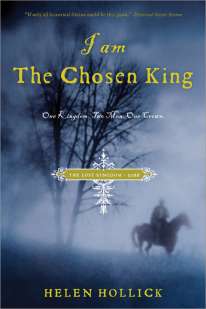
Guest Author, Helen Hollick on the History Behind Her Book -- I AM THE CHOSEN KING

I would to welcome guest author, Helen Hollick to History Undressed! Today, she has written a fascinating post for us on the history behind her book, I Am The Chosen King. I asked Helen three different questions, which she's graciously answered below...

Eliza Knight: Could you tell us a little about the research behind the book, particularly any unique, or intriguing findings?

Helen Hollick: I spent a year researching I Am The Chosen King (Harold the King is its UK title) I was undecided about what to write after completing my Pendragon’s Banner Trilogy, but the story of the Battle of Hastings and 1066 was stirring some interest – not least because Harold Godwineson is a local hero: as Earl of Essex he founded Waltham Abbey which is about fifteen minutes’ drive from where I live. His first wife came from a few more miles away. So I was rather attracted to writing about a man who could have walked where I could walk. (Unlike King Arthur who possibly never even existed!)
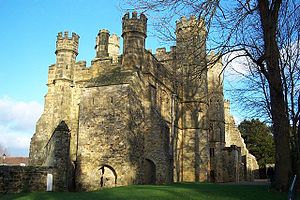

My mother, at that time, was the outings’ organiser for a local women’s group and she had arranged a visit to Hastings, a Sussex town on the south coast of England (for any of you who enjoy UK TV drama, Foyle’s War is set in Hastings) Part of the trip was a stop at Battle Abbey and the site of the Battle on the way. There was a spare seat, so I went along.

In 1066 there was nothing at the place except a steep hill, thick forest and marshland, now there is the remains of the Abbey Duke William built in penance for the number of deaths he caused. The old buildings are partially turned into a girl’s school now. The town that grew up around the abbey while it was being constructed is actually called Battle.

When we got there it was starting to drizzle with rain so all the ladies hurried into various tea shops and cafes. I went to the battlefield, determined to walk the site. As it turned out doing so in the rain was the best possible strategy because I had the place all to myself!

I won’t go into details of the history of the battle – the most famous in all English history - suffice to say the English, Harold and his men, had formed a solid “shield wall” of men along the top of the ridge, and Duke William’s Norman army was at the bottom of the hill. The battle itself lasted all day. (For more detail read the book! :-)
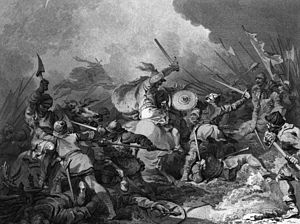
I started trudging down the right hand side, hands in pockets, head bent against the rain. Suddenly, the hairs on the nape of my neck prickled. I stopped and I had an overwhelming feeling that if I turned round I would see the English army arrayed along the ridge….. I missed the moment. When I did turn round there was nothing. All the same I have never forgotten the experience.

Soon after I had a vivid dream. I saw four men, Saxon noblemen by the style of their dress, riding alongside the river Lea. Three of them were arguing, the eldest, obviously the father, was reprimanding them. The dogs sent up a pair of ducks, but one of the men was looking across the river at something – someone – hiding beneath the trees. A moment later I saw a girl dart out and run up the slope of the meadow, her kingfisher blue cloak and fair hair streaming behind her.

I knew, without a doubt, that I had just seen Earl Harold, his father, Godwine of Wessex and his two brothers, Swegn and Tostig… and the young Edyth Swanneck who was to become Harold’s wife.

You’ll read the scene in the book. Chapter two.

Eliza Knight: Tell us about the history behind the setting of I Am The Chosen King.

Helen Hollick: The series of events that led to 1066 is rather a long and complicated story – hence the thickness of the novel! Perhaps all I shall say here is that Duke William of Normandy had no right to the English throne, that Harold was our last, legitimate, legally crowned English King, and he is the only King to die fighting to save his Kingdom and people from foreign invasion.
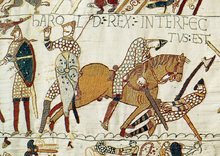
That makes him a hero in my mind.

I wanted to write Harold’s story; the story of the events that led to that fateful battle in October 1066, because I wanted to set the history – from the English point of view – straight. I was so tired of reading in history books that English history started with the Norman Conquest, that William was a great King, that the Normans had conquered a “dark age” backward, uncivilised, country. I wanted to unravel the Norman propaganda and write a novel that told a little more of what is probably nearer the truth.

Eliza Knight: I can't think of a better reason to write a book, and I do believe you nailed it! Is there any topic historical in nature, related somehow to the book, but that readers would find fascinating? Of particular interest to my readers are era-related food, fashion, mannerisms, scandals, lifestyles.

Helen Hollick: Scandals? Oh there was a huge one! Harold’s elder brother, Swegn, kidnapped an abbess and held her prisoner for over a year. It was Anglo Saxon Headline news for months!

Of course, we don’t know the actual details, and I personally don’t think Swegn, for all his reckless faults, was that stupid. I’m pretty certain he knew the woman, and it is quite possible that she never really wanted to be incarcerated in an abbey in the first place! Younger daughters were often “given” to an abbey as a nun basically as a way of buying God’s favour for the family. Widows, especially if they were rich, sometimes sought sanctuary in an abbey as a way of avoiding being pestered to remarry. For many it was a welcome escape, for others it must have been like being imprisoned.

I think it is very probable that Swegn and the abbess knew each other and he was attempting to rescue the poor soul. I use the episode in I Am The Chosen King though, so I’d better not give away any spoilers had I?

One thing to remember at this time, it was not considered wrong, or illegal for a man (especially a nobleman) to take what we would now call a “Common Law” wife. Their union would be a simple handfasting, not a wedding blessed in church, but the marriage would have been legally binding and any children would have been fully legitimate.

Harold’s first love, Edyth Swanneck was his Common Law wife for more than twenty years. They had at least six children. I thought it so sad when he had to set Edyth aside once he was crowned King… oh spoilers again! Sorry!

Ms. Hollick, thank you ever so much for posting with us today! I enjoyed your answers, and find that time period to be fascinating. Truly, I AM THE CHOSEN KING was a riveting and intriguing tale! I highly recommend reading it! And guess what? One lucky commenter today will win a print copy of I AM THE CHOSEN KING, so comment away!

Visit Helen Hollick at http://www.helenhollick.net/

Monday, March 7, 2011

Guest Author, Sarah Bower on the History Behind SINS OF THE HOUSE OF BORGIA

Today I would like to welcome guest author Sarah Bower to History Undressed. I am in the midst of reading Ms. Bower's book, SINS OF THE HOUSE OF BORGIA right now and thoroughly enjoying it. I've asked Ms. Bower if she'd give us a bit of history on her research for the book, and any unique or intriguing findings.  I hope you enjoy her post as much as I did! Thank you Ms. Bower for your wonderful post!

*****

Let me begin by thanking you for inviting me to guest on History Undressed, and for all the great comments your readers made in the competition to win a copy of SINS OF THE HOUSE OF BORGIA. Really hope the winner – and everyone else – enjoys the book.


Lucrezia
I’ve been researching the Borgias since I was fourteen and developed a major crush on Cesare after reading Jean Plaidy’s Madonna of the Seven Hills and Light on Lucrezia. Handsome, clever, wealthy, successful and just a frisson of danger thrown in for good measure. What’s not to like? The next book I read was Machiavelli’s The Prince, and you could say I’ve been researching the Borgias ever since, though, over the years, my interest in Lucrezia has grown. Both brother and sister are fascinating, contradictory characters, but coded letters of Lucrezia’s revealed by Sarah Bradford in her book Lucrezia Borgia: Life, Love and Death in Renaissance Italy show that the traditional view of her as a pawn in her father and brother’s games is short of the mark. I’ve tried, in SINS OF THE HOUSE OF BORGIA to show her acting independently and demonstrating just as much political skill and acumen as the Borgia men.

This is one reason why I chose to set the novel mainly in Ferrara, where Lucrezia went on her third and final marriage to Alfonso d’Este, the Duke of Ferrara. A visit to that beautiful town on the River Po quickly reveals how differently their famous duchess is regarded there to the image of helpless girl or the scheming adulteress beloved of Donizetti and Victor Hugo. To the Ferrarese, she is a great patron of the arts, the dedicatee of Ariosto’s Orlando Furioso, and a heroine of the city’s resistance to an invasion by Papal forces in 1509. Most fiction about Cesare and Lucrezia focuses on their early years in Rome, when they were beset by scandal and sensation, but I found myself more interested in finding out about the people they became after they grew up, their capacity for survival and endurance, what – I suppose – has made them stay in history’s consciousness when so many of their equally brilliant contemporaries have faded.

The key that unlocked all this, however, was discovering Violante. Among the entourage which accompanied Lucrezia to Ferrara was a converted Jewess called Violante. This is recorded, as is her betrothal to an unknown man around 1503, but the rest is a blank for the novelist to fill in, and suddenly, a plot began to fall into place. In 1492, the year Lucrezia’s father became Pope Alexander VI, the Jews were expelled from Spain by Ferdinand and Isabella. In that diaspora I found my starting point, the event that would, eventually, cause Lucrezia’s and Violante’s paths to converge.

It’s important to me to have a strong sense of place for the settings of my novels, which meant spending some time in Ferrara, just twenty minutes by train from Venice and, perhaps because of that, unjustifiably overlooked. Little of the city Violante would have known is left after an earthquake in 1570, but the castle in which she would have lived is largely intact.

Cesare
What really brought her world to life for me was not the grand public rooms, most of which have been rather poorly restored, but a tiny dungeon in the castle’s basement, the door so low I had to bend almost double to enter a room no more than a couple of feet wide and about eight feet long and without any natural light. It lies below the level of the moat and, even on a warm March afternoon, was freezing cold and damp. This is where one of Alfonso d’Este’s brothers was imprisoned after unsuccessfully plotting against him. Standing there in the dark, thinking about his fate, I was forcefully struck by the darkness which underlies the glories of the Italian Renaissance.

Let’s take a peek at a letter written by Isabella Gonzaga, Lucrezia’s sister-in-law, to her husband, Francesco, who was obliged to stay away from the wedding by a recurrence of syphilis. ‘Yesterday,’ she complains, ‘we all had to remain in our rooms until the twenty-third hour[approximately six in the evening] because Donna Lucretia [sic] takes so long to rise and dress herself...’ Elsewhere Isabella jealously itemises pieces of the Este family jewels worn by Lucrezia at the wedding celebrations – a diamond and ruby necklace, a headdress loaded with spinels, diamonds, sapphires and other precious stones and some ‘very large’ pearls. It’s almost as if she knew the elegant Roman girl, with her glamorous style and decadent manners, was destined to become the love of Francesco’s life.

Underneath all this glitz and glamour lies a dark region of violence, superstition and disease. Murdered enemies were displayed in ritual ways worthy of the grisliest crime fiction – hung in cages from battlements, laid out on the executioner’s block with the axe still embedded in their necks, tied back to back and garrotted. Virulent malarial plagues swept Ferrara every summer. Of the four children of Pope Alexander VI and Vannozza Catanei, only Lucrezia survived her mother. One son was murdered, another died in battle, the third of a fever. Lucrezia herself endured nine pregnancies and gave birth to five living children, two of whom died in infancy. She died in childbirth in 1519, the last of the House of Borgia.


Leave a comment for your chance to win a copy of SINS OF THE HOUSE OF BORGIA. (US/Canada only)

A Notorious Duke
An Infamous Duchess
An Innocent Girl

Violante isn’t supposed to be here, in one of the grandest courts of Renaissance Italy. She isn’t supposed to be a lady-in-waiting to the beautiful Lucrezia Borgia. But the same secretive politics that pushed Lucrezia’s father to the Vatican have landed Violante deep in a lavish landscape of passion and ambition.

Violante discovers a Lucrezia unknown to those who see only a scheming harlot, and all the whispers about her brother, Cesare Borgia, never revealed the soul of the man who dances close with Violante.

But those who enter the House of Borgia are never quite the same when they leave—if they leave at all. Violante’s place in history will test her heart and leave her the guardian of dangerous secrets she must carry to the grave.