Above painting: Louis Jean Francois - Mars and Venus an Allegory of Peace

Pages

***All photos accompanying posts are either owned by the author of said post or are in the public domain -- NOT the property of History Undressed. If you'd like to obtain permission to use a picture from a post, please contact the author of the post.***

Tuesday, November 13, 2012

Society Norms and How Caroline Montague Thwarts Every One by Christy English

Today I'd like to welcome historical romance author, Christy English to History Undressed! Today she's written a post on society norms during the Regency. Enjoy!


Society Norms and How Caroline Montague 
Thwarts Every One
by Christy English


The Regency Period was a time of calm conversation and sedate dancing. A time when the waltz was considered a little scandalous, and an unmarried woman would never consider dancing it without the permission of Almack’s.

It isn’t that Caroline Montague, the heroine of my novel HOW TO TAME A WILLFUL WIFE, doesn’t know these things. Her mother did her level best to raise Caroline to behave like a lady. It’s simply that Caroline doesn’t care what anyone else thinks.


In Regency England, it is best if a young lady is seen and not heard. A young lady should sit demurely and wait at her mama’s side until a gentleman asks her to dance. A young lady might shoot a bow and arrow, but never in competition with gentlemen who would clearly best her in any contest.

Caroline has never waited for permission to do anything in her life. She enjoys dancing, but she prefers country dances to the waltz. She finds it simpler to lead the young men she knows instead of letting them lead her. Caroline loves her bow so much that she keeps it in her bedroom, along with her throwing knives. She doesn’t hesitate to outshoot the men around her whenever she can, and she takes pleasure in her victory.


A Regency lady should always wear a riding habit when on horseback. Caroline prefers to ride in breeches, astride her war stallion, Hercules. Occasionally, she makes the concession of hiding her breeches underneath a gown, but not often.

Would a woman in Regency England have been allowed to break as many social conventions as Caroline does? I don’t think so. Which is all the more reason I enjoyed creating this woman, and watching her thwart every convention put in front of her. She does learn to compromise after she is married, but so does her husband Anthony. In the end, neither is truly tamed. They finally learn to communicate with each other, and to live together as equals. Caroline keeps her bow and her knives, but she and Anthony learn that when they spar together, it is better to use blunted blades.


Leave a comment for your chance to win a copy of Christy's new book!


How to Tame a Willful Wife by Christy English

A clever Regency retelling of “The Taming of the Shrew”

Anthony Carrington, Earl of Ravensbrook, returns from war to marry his commanding officer’s daughter. A man of fiery passion and strict self-control, Anthony expects a biddable bride who obeys him without question. But Caroline Montague is no simpering miss; she rides a war stallion named Hercules, fights with a blade, and can best most men with both bow and rifle. It’s a duel of wit and wills in this charming first book of a new series.

Visit the author at her website: http://www.christyenglish.com/

Monday, November 12, 2012

The Colonial Frontier and Beth Trissel's New Historical!


Welcome back to today's guest on History Undressed, historical romance author, Beth Trissel! We're glad to have you back! And congrats on your newest release!


Thanks for having me on your splendid blog, Eliza. Always an honor. Today I’m sharing the turbulent history behind my new historical romance novel, Kira, Daughter of the Moon.

‘A beautiful Scots-Irish healer in the rugged Alleghenies finds herself accused of witchcraft. With the terror of the French and Indian War fresh in her mind, can Kira love a white warrior?’

Kira, Daughter of the Moon, the third in my colonial frontier series, follows Through the Fire and Red Bird’s Song. Though written to stand alone, Kira, Daughter of the Moon is the long-awaited sequel to Through the Fire and features strong secondary characters introduced in that novel, with the addition of the very unique heroine, Kira, and other new characters. The story also builds on the conflict between Scots-Irish settlers and frontiersmen, the Shawnee and their allies, and British mandates regarding the return of white captives depicted in Red Bird’s Song.

Set in the rugged Alleghenies in the colonial Virginia frontier, the story opens in the spring of 1765, about six months after the close of Red Bird’s Song in the fall of 1764. Through the Fire takes place the summer of 1758 at the height of the French and Indian War. For those of you interested in this obscure but vital era of American history, a second war lead by Chief Pontiac (who united a number of the tribes) followed on the heels of the French and Indian, a sort of part two. That’s the war wrapping up in Red Bird’s Song, but to anxious settlers the Indian Wars just flowed together with times when attacks were more prevalent than others. These harried folk trying to survive didn’t keep track of the names of the wars. They didn’t always even know which tribe was attacking them, and some war parties were a mix of allied warriors. But the Shawnee gained the distinction of being the most feared tribe in the Shenandoah Valley and the Virginia frontier—the ultimate badass. The French officers who lead some of these attacks were particularly hated, to this day in some mountainous regions of Virginia and now West Virginia. Memories run deep. Bear in mind that Virginia used to be vast and encompassed states.

Dread of Indian attacks, of being killed or captured, of what happened to captive loved ones, and mistrust of white men who turned renegade and ran with war parties was on the minds of these mistrustful and superstitious Scots-Irish. Not that all settlers were Scots. Some were German/Swiss and English, but the clannish Scots tended to band together. And this is the volatile background for Kira, Daughter of the Moon.

Blurb:
Logan McCutcheon returns to colonial Virginia after seven years in the hands of Shawnee Indians. But was he really a captive, as everybody thinks? He looks and fights like a warrior, and seems eager to return to those he calls friends and family.

Kira McClure has waited for Logan all those years, passing herself off as odd to keep suitors at bay––and anyone else from getting too close.  Now that he's back, he seems to be the only person capable of protecting her from the advances of Josiah Campbell and accusations of witchcraft.  And to defend the settlers against a well-organized band of murderous thieves.

About Beth Trissel: Married to my high school sweetheart, I live on a farm in the Shenandoah Valley of Virginia surrounded by my children, grandbabies, and assorted animals. An avid gardener, my love of herbs and heirloom plants figures into my work. The rich history of Virginia, the Native Americans and the people who journeyed here from far beyond her borders are at the heart of my inspiration. In addition to American settings, I also write historical and time travel romances set in the British Isles. For more on me, my blog is the happening place: One Writer’s Way


***Kira, Daughter of the Moon is available in print and kindle at Amazon, in print and various eBook formats at The Wild Rose Press, and from other booksellers. If you would like to be considered for a giveaway of the novel in pdf or kindle format, winner’s choice, please leave me a raving comment.


Thursday, November 8, 2012

Weird & Interesting Things About Medieval Times by Lana Williams

Today I'd like to welcome Lana Williams to History Undressed! She's written a fun post on the weird and interesting! Enjoy!


Thank you so much, Eliza, for having me at History Undressed!  The second book in my medieval romance trilogy, Trust In Me, is now available on Amazon. To celebrate this, I thought I’d share some of the weird and interesting things about medieval times that I like to sprinkle in my stories.  I find these tidbits fascinating as they help reveal what life was like on a daily basis.

I’m giving away a free Kindle e-book of Trust In Me, so please leave a comment!

Here are some weird and wonderful things you might find interesting:


  • Cattle and sheep horn served as the plastic of the Middle Ages. It was light and strong, doesn’t absorb flavors like leather or wood, and wasn’t hard to manipulate into the shape needed. The horn would be soaked in water for up to three months to soften it, then unwound and flattened.  Items such as spoons and musical pipes were made from horn.  The center of the horn could be split and polished and used as a substitute for glass in windows. While you can’t see through it, it does allow light in. Horns could also be hollowed out to use as a container for herbal remedies and other items.
  • Spices were expensive but used heavily especially during a feast to show wealth.  An ounce of pepper could cost a laborer as much as a day's wages or more.
  • Herbs played a big part in both medical treatment and in daily household uses and I noted some uses in both books of my medieval romance trilogy, A Vow To Keep and Trust In Me.  Lavender was scattered on straw mattresses to improve the smell and to keep fleas away.  Rushes (tall, grass-like plant) were spread about the floor of the great hall and gave off a pleasant fragrance when stepped on and sometimes herbs were added to these. Marjoram might be used in a healing poultice to place on bumps and bruises. Lemon balm was thought to cure many serious illnesses. Many medicinal journals suggested the healing herbs be picked on particular days thought to be magical, such as Midsummer’s Eve. 
  • Spinning thread was done by women using hand-held spindles similar to the picture displayed. Often, single women made a living spinning thread, which is where the term “spinster” came from. Medieval sheep produced only one-third of the wool that modern day sheep do. 
  • Livestock vs. deadstock. Livestock, as most of us know, refers to cows, sheep and the like. Deadstock refers to tools, carts, and most other things not “live”. 
  • Animal fat had a multitude of uses from making tallow candles to preventing armor from rusting to greasing cart axles.
  • Bloodletting, used since ancient times, was considered a cure for nearly any ailment. Just as it sounds, a physician cut open a vein and allowed the blood to run out. When the treatment was done and which vein was used could depend on the color of the patient’s urine or what phase the moon was in. Unfortunately, the practice was rarely successful.
  • At meal times, tables were often set with the spoons facing down to keep evil spirits from lingering there. Most everyone brought their own knives to use, but spoons were usually provided. Forks were not yet invented, but using your fingers was perfectly acceptable.
  • Early halls and peasant cottages had a hearth in the middle of the room, which meant people’s clothes smelled of smoke. Since people’s outer garments were rarely washed, the smoke scent acted like a deodorizer.  Wall fireplaces eventually become popular as they had a flue to carry away the smoke.
These sorts of details make understanding daily life all the more vivid, don’t you think?

Trust In Me is set in England in 1268. It’s the second story in The Vengeance Trilogy - three books that show how a quest for revenge can change in a heartbeat. 

When his brother is abandoned near death at the gate of his keep, Lord Nicholas de Bremont seeks revenge against those he believes guilty: Lord Crefton and his treacherous daughter, Elizabeth. But the old lord is too feeble for Nicholas to fight. Desperate to protect her father, Lady Elizabeth offers to take his place, but as Nicholas’s wife.

Nicholas vowed never to have a family and risk passing his cursed second sight on to a child, yet how else can he make Crefton suffer but to take away his only daughter? Determined to make Elizabeth pay for her part in his brother’s injuries, he adds a punishing stipulation to her offer--he refuses to bed her, dashing her dream of a family.

As they feign a true marriage, Elizabeth tries to guard her heart from the angry lord who appears to despise her, yet his small acts of kindness crumble her defenses. Nicholas attempts to keep his distance from the beautiful lady, terrified Elizabeth will unveil his dark secret, but is tempted every moment he's with her. When his visions divulge a villain who intends her harm, Nicholas must choose whether to accept her trust and love, or keep his secret and claim vengeance.

Don’t forget to leave a comment to get a chance to win a Kindle e-book of Trust In Me!  Thank you so much, Eliza, and History Undressed!


Trust In Me (The Vengeance Trilogy-Book II) http://amzn.to/PB1td7

A Vow To Keep (The Vengeance Trilogy-Book I) http://amzn.to/Vzf0Vi

FB:  Lana Williams Books  http://on.fb.me/QkYcQs        Twitter: LanaWilliams28

Author Bio:

Lana Williams writes historical romance filled with mystery, adventure, and a pinch of paranormal to stir things up. Her medieval romances begin with A Vow To Keep, the first in The Vengeance Trilogy, followed by Trust In Me, the second.

Filled with a love of books from an early age, Lana put pen to paper and decided happy endings were a must in any story she created. She writes in the Rocky Mountains with her husband, two growing sons, and two dogs.


Tuesday, November 6, 2012

Election Day!

In the USA, it's Election Day! Don't forget to get out there and vote!!! What happens if there is an electoral college tie?


 And just for fun... A Rap Battle :)


Monday, November 5, 2012

“Till Death do us Part” – Introduction to the Laws of Marriage by Alison Stuart

Welcome back to History Undress, Alison Stuart! Today she's here with another fascinating post on the Laws of Marriage! Enjoy!


“Till Death do us Part” – Introduction to the Laws of Marriage

Alison Stuart


*This article originally posted here.

In my last post I wrote about the Laws of Succession. Continuing on the "property" theme, this post is a short guide to the laws of marriage in England.


The laws of marriage went beyond being merely a civil contract, they significantly altered the status of an individual (the woman) in respect of her actions, obligations and property.  Because it was also considered a "holy estate", canon law as well as civil law had to be taken into account. Until the nineteenth century, questions of "Marriage" were the almost exclusive jurisdiction of the Church.

Marriage required not only the solemnisation provided by the church but also the "physical union of man and woman in carnal copulation" (and because I love latin legal maxims, here's the maxim for the day "commixtio sexuum"). Because there could be copulation without marriage, it was decided that an intention to marry (a mental element) had to be present and according to Canon Law (and at least until 1753) a promise to marry someone could be held as an indissoluble union, a contract of marriage between two people by consent alone without any form of ecclesiastical ceremony, provided the consent was given in words of the present tense...”I am marrying you...” as opposed to “...I will marry you...”. These irregular marriages were generally legitimised by the parties being compelled to solemnise their marriage publicly at the door of the church. In the event of a dispute with a later marriage, this irregular marriage would be upheld. This archaic concept of marriage lingered through to the 1970s in the form of an action for “breach of promise of marriage”.

For a marriage to be “regular”, publicity of the intention to marry came into formal existence by 1200 when Archbishop Walter required banns to be published on three separate occasions. The calling of banns allowed the congregation to declare any impediment to the marriage such as consanguinity or pre contract.

In these early days, the marriage took place at the door of the church. The priest would call on the couple to declare any impediment. The parties would then speak the words of betrothal and present matrimony and the husband would then place a ring of the wife’s finger (the wearing of wedding ring by a man is a modern concept) and deliver to her the tokens representing dower (see my last blog). The ceremony would conclude with a nuptial mass inside the church.

In 1753 Lord Hardwicke’s Act abolished secret marriages. The publication of banns, the purchase of a licence, the presence of two witnesses and the recording of the marriage in a public register were made compulsory. Interestingly Jews and Quakers were exempt from this Act and there was no special provision for Roman Catholics and non conformists. This was not remedied until 1836 when the civil marriage ceremony was introduced and Non conformist places of worship could be registered under that statute. 

Husband and wife were seen in the eyes of both canon and common law as one person (here comes another legal maxim:  erunt animae duae in carne una).  This one person was, of course, the husband. Modern women may cringe at this quote from Blackelocke "...the very being or legal existence of a woman is suspended during marriage, or at least is incorporated and consolidated into that of the husband...". Of course the origin of this is scriptual, reflecting the Canon Law influence on marriage.

A wife could not own property or enter into contracts.  Only acting as an agent for her husband could she make valid contracts. Married women were only given the same contractual rights as men as late as 1935.

Neither could she sue or be sued and nor could she take any legal action against her husband because they were seen to be “one person”.  In the case of injury to the wife, a husband could sue for loss he suffered through the loss of the wife’s services or society (consortium). He could sue in trespass against a man who committed adultery with his wife. If the wife absconded with her lover, an action for “enticement” could be brought against the lover, alleging the defendant had maliciously schemed to deprive him of his wife’s consortium by enticing her away. This action was not abolished until 1970! No corresponding rights existed for the wife.

On marriage any property which the woman owned as a single woman became the husbands and could be disposed of by him without recourse.  You may recall from my last post, if the husband predeceased the wife she could claim one third of his estate if he died intestate (without a will). If he died testate (with a will) she was only entitled to whatever legacies he saw fit to leave her. Interestingly although a wife’s real property brought by her into the marriage, vested in her husband during the marriage, if she predeceased him he was only entitled to a tenancy by the courtesy. A husband could dispose of her property but on his death the wife would be entitled to claim it back. However if she wanted to alienate the land during her husband’s life time, she would have to have his assent. Any grants of property to the wife during the marriage, vested the property in the husband.
 
By the eighteenth century an equitable doctrine of "separate use" had begun to be used. In equity, a husband and wife could be seen as separate people and property settled on the wife during marriage could be held on trust for the wife's separate use. Judges noted with concern that this could lead to the wife being coerced into disposing of her equitable estate to her husband and a far thinking judge solved the problem by inserting "the restraint on anticipation" condition into a settlement which prevented the wife from alienating or charging the property during her marriage. This protected the property for the wife until widowhood. It also prevented her from disposing of it legitimately in any other form!

While this equitable doctrine applied nicely to the landed classes, it did nothing for the poorer classes. By the middle nineteenth century, after intensive lobbying, the equitable doctrine of separate use was extended to wages and earnings of working women. This provided some modest protection for those women who worked to keep their families together only to have their husbands take their humble earnings. A further reform in 1882 extended this to property of a married woman, whether acquired before or after a marriage.

Reference:  An Introduction to English Legal History: J.H. Baker

Alison Stuart is an award winning Australian writer of historicals with heart.  Whether duelling with dashing cavaliers or waywards ghosts, her books provide a reader with a meaty plot and characters who have to strive against adversity, always with the promise of happiness together. Alison is a lapsed lawyer who has worked in the military and fire service, which may explain a predisposition to soldier heroes.  She lives with her own personal hero and two needy cats and likes nothing more than a stiff gin and tonic and a walk along the sea front of her home town.  She loves to hear from her readers and can be found at her website, facebook, twitter and Goodreads. Her latest book, GATHER THE BONES, is a “Downton Abbeyesque” haunting love story set in 1923.

Friday, November 2, 2012

A Steamy Bath (excerpt from THE HIGHLANDER'S REWARD by Eliza Knight)

When writing my historical romances, I try to stay true to history and the era of the story I'm creating. At the same time I like to make things sensual, after all, it is a romance. Today, I'm presenting you with an excerpt from THE HIGHLANDER'S REWARD...

A Steamy Bath...


“I need a bath and a shave.” Magnus held Arbella's hands up to his mouth and kissed her fingertips. “And I would think ye’d be happy for the pleasure of a warm bath, would ye not?”
Arbella swallowed, not sure if she trusted herself enough to speak yet.
Magnus pressed a hot, entirely too quick, kiss to her lips before leaving the room. She could only stand there, trying to explore what had just happened between them. Trying to understand the sensations whipping through her body, the turmoil in her mind. Magnus made her feel things, showed her things, she didn’t think were possible. He was opening up her eyes to a whole new world. A world of pleasure, desire, and more importantly a world where a man was strong yet sensitive to a woman’s needs. He was showing her by his actions that he was not a barbarian. She smiled a little at this knowledge. As much as he wanted to pretend he was a hardened warrior, no hard-hearted man would caress her the way he did. A barbarian would not care that she had a bath, or that her hands trembled when they entered his courtyard.
Magnus was a big, soft-hearted, man, even if he tried to hide it. She’d found out his secret.
When her husband returned several minutes later, he was followed by two servants carrying a large wooden tub—large enough for Magnus to fit in, and a half dozen others carrying buckets of steaming water, linens and balls of soap.
They set down the tub, lining it with one of the linen towels, then dumped in the water. They left and returned with more buckets until the tub was half full. Steam curled into the air from its depths. Oh, how she wanted to sink into that tub, to scrub away the dirt from her travels.
She startled as the door shut on the last servant. Her gaze was drawn, with alarm, to Magnus as he started to undress.
“What are you doing?” she asked.
“Taking a bath.”
“I will come back.” She scurried toward the door.
“I dinna plan on taking my bath alone, Arbella.”
“What?” she gasped.
Her mother had assisted the baron with his bath, would she be expected to do the same? Her heart raced, her palms grew damp.
“Ye dinna want to bathe?”
Her back was still to him, the door and escape only inches away. From behind, she heard the slosh of water. He was in the tub. If she turned around, she’d see the breadth of his naked shoulders, his chest wet from the water… The visions she created in her own mind had her wayward nipples hardening once more.
She pressed her lips together and then forced herself to speak. “I do want to take a bath, but I had thought to take a bath…alone.”
“Ah. But ’tis more fun to take a bath together.”
She gulped, afraid the sound echoed off the walls.
Magnus chuckled behind her. “Turn around, lass.”
Arbella turned in a slow circle, her eyes wide, her throat constricted.
Even the visions she’d imagined in her mind did no justice to the vision of her very nude husband soaking in the massive tub. He was glorious. Perfection sent from the devil to tempt her into wickedness.
He grinned at her, roguish and sensual. “Well?”
“I cannot take a bath with you.”
“Suit yourself. Will ye at least wash my back?”
“What?” she whispered. He wanted her to touch him? To stroke soapy fingers over his taut flesh?
“Come now, dinna be shy with me.”
She stepped forward, curiosity getting the better of her. She wanted to wash his back. To touch him. To breathe in his intoxicating scent.
His smile was inviting and his eyes followed her as she came closer.
Arbella rolled up the sleeves of her gown and knelt behind him.
He handed her the soap and a small linen square. “Here.” His voice was gravelly, like he was holding back something in his throat.
She dipped the linen in the water and lathered the soap onto it, then she stroked the cloth over his shoulders. Magnus sighed and sat forward, allowing her greater space to wash him.
“That feels wonderful, lass,” he mumbled.
She nodded, even though he couldn’t see her. It did feel wonderful. She rinsed the cloth then wiped off his lathered flesh with water.
“All finished,” she said, annoyed at the quiver in her voice.
“But ye haven’t done the front.”
The front… The wicked side of her wanted desperately to do the front. The part of her that wanted to remain chaste and return to England resisted.
“I cannot do the front. ’Twouldn’t be decent.”
“My sweet, we are beyond decent already.”
He was right. Her face burned with the memory of his mouth on her bare flesh. Besides, it was only a bath. It couldn’t hurt to wash his chest… But she would not wash that part of him.


WANT MORE???? BUY IT HERE (Print or Ebook): Amazon / Barnes and Noble / Smashwords


She belonged to another… But was destined to be his…

Lady Arbella de Mowbray abhors the idea of marrying an English noble occupying Scotland. When she arrives in Stirling, she is thrown into the midst of a full battle between the Scots and the English. Besieged by rebels, she is whisked from her horse by a Highland warrior who promises her safety. But when he kisses her she fears she's more in danger of losing herself.

The last thing Magnus Sutherland wants is to marry the beautiful English lass he saved. As the laird of his clan, he has a responsibility to his clan and allies. But when Arbella is attacked by one of his own men, he determines the only way to keep her safe is to make her his. A decision that promises to be extremely satisfying.

Magnus brings Arbella to his home of Dunrobin Castle in the Highlands. And that’s where the trouble begins… Their countries are at war and they should be each other’s enemy. Neither one considered their mock marriage would grow into a deeply passionate love. What’s more, they were both unhappily betrothed and those who've been scorned are out for revenge. Can their new found love keep them together or will their enemies tear them apart?

BOOK TWO: The Highlander's Conquest -- out now!
BOOK THREE: The Highlander's Lady -- Releasing 12/15!


Thursday, November 1, 2012

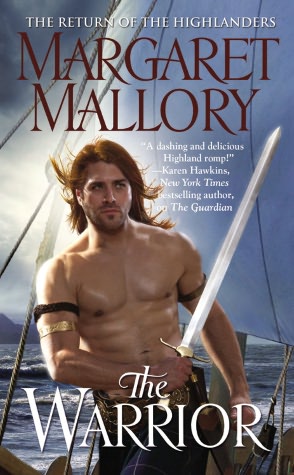
Margaret Mallory Talks About Researching Her Latest Scottish Romance


*All photos are the property
of the author, Margaret Mallory
Welcome back to History Undressed, guest author, Margaret Mallory! Today she's here giving us an inside view of the research behind her latest Scottish romance, THE WARRIOR, which has been met with rave reviews! Enjoy!

To research THE WARRIOR, I poured over books and articles, as I usually do. But the two things I did that made the biggest difference for my story was making some four-legged friends and listening to a song.

When I realized that I’d written five books without a single dog—not counting the brief appearance of that unpleasant one on Queen Margaret Tudor’s lap—I decided to include one in THE WARRIOR. Most breeds we know today did not exist in early 16th century Scotland, so I didn’t have many choices. Some variation of terrier was probably on the Isle of Skye in 1516, but a terrier didn’t seem like quite the right dog to pair with Duncan MacDonald, the most alpha of my alpha warriors.

I’d nearly settled on the Scottish Deerhound, a graceful hunter, when I came across its larger cousin, the Irish Wolfhound. According to the American Kennel Club, the wolfhound has a “commanding presence,” is “remarkable in combining power and swiftness,” and is “muscular, strong though gracefully built.” While fierce enough to fight wolves, this dog is also loyal, steadfast, and oh-so-handsome.

Laugh, but the more I read about the wolfhound, the more this dog seemed just like my hero. How fortuitous that my heroine is in Ireland in chapter 1. Clearly, this dog was meant to be in my book. I named him Sàr, a Gaelic word for warrior.

Because I’d never met a wolfhound, a friend took me to visit a woman in town who owns three. I fell in love instantly. These dogs were everything I’d read about and more. The second time I visited, one of the dogs had 12-week-old puppies. Research should always be this fun!

The owner assured me that these gentle giants could take down wolves and shared this expression that is used to describe them:  Gentle When Stoked, Fierce When Provoked.

That’s how I found a dog for my book. Now, for the musical research.

Through constant training, determination, and natural talent, Duncan MacDonald has become the most fearsome warrior in his clan and captain of his chieftain’s guard. Early on, I decided that such a tough hero needed an unexpected trait to add another dimension to his personality and reveal his heart. So I made this hardened warrior musical.

In the first two books of the series, Duncan showed this talent mostly by playing sad tunes on the six-hole whistle--a precursor of the tin or penny whistle—that he carries attached to a leather thong around his neck. I confess that in THE GUARDIAN I made a mistake—gasp!—by making his whistle metal. I’ve learned since that this would be extremely unlikely, so Duncan’s whistle is now made of bone.

Despite my gross error, Duncan’s whistle seemed to work, judging from the extremely positive reader mail I received about him. I was a wee bit worried, however, about handling Duncan’s musical talent when he took center stage in his own book. Clearly, Duncan would need more than a whistle. And I, alas, am utterly lacking in musical talent.

Regardless, I forged ahead and made my warrior one of those truly gifted musicians who can play almost any instrument he picks up. From his mother, he learned to play the harp. The harp was the Celtic instrument for centuries and was still played after the pipes became the symbolic instrument of the Highlands. I can’t tell you when the pipes became important, but it was probably sometime during the 1500’s that every chieftain worthy of the name had to have a piper.

A number of people in a Highland castle might know how to strum on a harp, to varying degrees, but having my hero play the pipes, even a little, seemed risky. As best I can tell, it was around the time of my books that piping families emerged, and their members spent years and years learning their craft.

The MacCrimmons were the most renowned of the piping families. To help his musical ability seem more credible, I gave Duncan a MacCrimmon piper as his maternal grandfather. (In my book, the MacCrimmons have started their famous piping school on Skye, but that probably happened later.) The MacCrimmons served as the hereditary pipers for my hero’s enemy clan, the MacLeods, which added intrigue to my plot.
I already had Duncan playing three instruments. I had no plans to make him a singer.

That changed the day I happened to listen to the words to the traditional song, Black is the Color of My True Love’s Hair. The description of the woman could have been written for Moira, my heroine, and the longing of the song reflected Duncan’s feelings for her perfectly. When I heard it, I knew Duncan not only had to sing, but that he had to sing this particular song if it was historically possible.

Fortunately, it was. I discovered that the song is from Appalachia, but it’s believed to have originated in Scotland. I listened to this beautiful, emotional song countless times, weeping over my laptop while writing poignant scenes in THE WARRIOR.

The second song I listened to endlessly for inspiration while writing this book was Gerard Butler singing Galway Girl, from the movie P.S. I Love You. I know Galway is in Ireland and the song isn’t nearly old enough, but Gerard helped me envision an alpha-warrior Scot who is even sexier and more manly when he sings.

I’d love to respond to questions or comments!  Tell me if you like the idea of a dog as a character or what kind of music you listen to for inspiration—or anything else. I’ll give away a signed copy of THE WARRIOR to one of the commenters.

~*~*~*~*~

“4 ½ Stars! Top Pick!” RT Book Reviews

“THE WARRIOR is heartbreaking, filled with tension, breathtaking passion and nonstop adventure...A perfect romance…Superb storytelling!” 5 Blue Ribbons, Romance Junkies


THE RETURN OF THE HIGHLANDERS: BOOK 3

Four fearless warriors return to the Highlands to claim their lands and legacies. But all their trials on the battlefield can't prepare them for their greatest challenge yet: winning the hearts of four willful Scottish beauties.

STAR-CROSSED

From the Isle of Skye to the battlefields of France, Duncan MacDonald has never escaped the memory of the true love he left behind. Deemed unworthy of a chieftain's daughter, Duncan abandoned the lovely Moira to prove his worth in battle. Now, when called upon to rescue her from a rival clan, one thing is certain: Moira's pull on his heart is stronger than ever.

Bartered away in marriage to a violent man, Moira will do anything to ensure she and her son survive. When a rugged warrior arrives to save her, the desperate beauty thinks her prayers have been answered-until she realizes it's Duncan. The man who once broke her heart is now her only hope. Moira vows never again to give herself—or reveal her secrets—to the fierce warrior, but as they race across the sea, danger and desire draw them ever closer.

Visit Margaret at her Website for links to read the book and an excerpt!