Marriage in the Highlands in the Early 1500’s*
Margaret Mallory
 |
| Dunscaith, home of the Chieftain of the MacDonalds of Sleat |
The most surprising thing I learned in my research for my
THE RETURN OF THE HIGHLANDERS series was about the marriage practices of Highlanders
in the Western Isles, particularly the chieftains, at that time my books take
place.
In the early 1500’s, these Gaelic-speaking Highlanders maintained
their old Celtic customs alongside their Christian beliefs. Priests were not
necessary to make a marriage, which was fortunate since priests were few and far
between in the Highlands at this time. In Celtic secular marriage, it was
common for couples to enter a trial marriage. At the end of a year, either
party could leave the marriage. If the couple decided to stick with it, they could
have their marriage blessed at the same time their first child was christened
when the priest made his rounds. Children
born of these trial marriages were considered legitimate, and men generally
claimed children born outside of marriage as well. Divorce was permitted by either party on
fairly loose grounds.
Chieftains, who were more than kings to their clans, disregarded
edicts from Rome as freely as they ignored edits from the Crown. For them, marriage was a means of making an
alliance with another clan—and they changed alliances all the time. Henry VIII had nothing on some of these
chieftains when it came to multiple wives, though a chieftain could simply “set
aside” a wife, rather than look for an excuse to have her killed.
 |
| Cawdor Castle |
The chieftains did not ignore the Church rules entirely, but
Rome was a long way away so they generally followed the principle that it was
better to ask forgiveness than permission. Though a chieftain might seek an
annulment, he was unlikely to wait the two or three years to get an answer from
Rome before taking a new wife. The petition
for annulment was often based on the marriage being in violation of the rules
of consanguinity, though everyone had been well aware of the issue at the time of
the marriage.
As might be expected, a clan chieftain’s serial (and
sometimes concurrent) marriages did not always lead to family harmony or good
relations with other clans. The MacDonalds of Sleat, the clan of my fictional
heroes, had their share of such conflict.
Hugh (Uisdean), the first MacDonald of Sleat and the
grandfather of my fictional character Connor, was one of three sons that
Alexander, the third Lord of the Isles, had by different women. Despite being
admonished by the pope himself for putting away his true wife and “adhering” to
Hugh’s beautiful and highborn mother, Alexander refused to part with her. His
half-sons, however, got along well.
Hugh had six sons by six different women, all from prominent
families. Unfortunately, his sons did not get along as well as Hugh had with
his half-brothers. In fact, Hugh’s first son hated his half-brothers so much
that upon his death he turned the clan’s lands over to the Crown to keep the
others from inheriting them. Though later chieftains held onto the lands, their
lack of legal title caused the clan problems for years. Two of Hugh’s other
sons were murdered by their half-brothers, and another was murdered by Hugh’s grandsons.
This family strife plays an important role in all four books
in THE RETURN OF THE HIGHLANDERS. In THE SINNER, I also included as secondary
characters two couples who were wed in order to make alliances between their respective
clans—with wildly differing results.
 |
| Margaret Mallory at Eilean Donan |
I drew on a well-known incident involving the Maclean
chieftain, Lachlan Cattanach (Shaggy), and his wife Catherine, whose father and
then brother were chieftains of the powerful Campbell clan. I won’t say here
what happened, but when Shaggy was found murdered in bed on a visit to Edinburgh
some years later, everyone assumed it was done by a Campbell in retribution.
Catherine’s brother John had better luck in marriage. When
the Thane of Cawdor died leaving his baby daughter Muriel as his sole heir,
clan chieftains all over the Highlands hoped to arrange a match that would
result in one of their sons becoming the next Thane of Cawdor one day. When
Muriel was still a toddler, the Campbell chieftain preempted the others by
having his men snatch Muriel when she was outside the walls of Cawdor Castle
taking in the fresh air with her nursemaid. Muriel was raised in the Campbell
chieftain’s household and married to John as soon as she reached twelve, the
age of consent. By all reports, this marriage, which was made solely for the
purpose of gaining lands and wealth for the Campbells, was a very happy one.
Then as now, some marriages turn
out well despite how they started.
* My primary source is “Marriage, Concubinage and Divorce in
Gaelic Scotland,” by David Sellar, from Volume 51 of the Transactions of the Gaelic Society of Inverness. (Thanks to Sharron
Gunn for referring me to the article.) I also found supporting information in
clan histories from numerous sources.
~~~
I hope you’ll
enjoy the slide show I put together of photos I took of some of the castles
& other settings that appear in THE SINNER. To see the show, click here ,
then click on “show info” on the upper right for descriptions.
For Book Group
Discussion Questions, blurbs, excerpts, and other information relating to my
books, please visit my website: www.MargaretMallory.com.
I’d love to
respond to your comments or questions! I’ll give away a signed copy of THE
SINNER to one of the commenters.
*~*~*~*
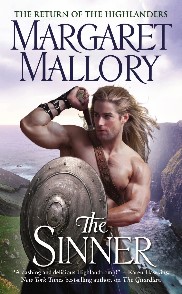
Four fearless warriors return to the Highlands to claim their lands and legacies. But all their trials on the battlefield can't prepare them for their greatest challenge yet: winning the hearts of four willful Scottish beauties.
IRRESISTIBLE DESIRE
Alex MacDonald is known for his skill as a warrior, his prowess with women, and his vow to never take a wife. But now his chieftain has asked him to make the ultimate sacrifice: wed Glynis MacNeil, a lass famed throughout the Highlands for her exquisite beauty—and defiant ways.Familiar with heartbreak, Glynis refuses to fall for another handsome scoundrel. Yet when Alex's past sins force an unlikely union, Glynis gives in to temptation and becomes his wife. Will their newfound passion be strong enough to fight the enemy that threatens their home, their clan, and their very lives?

