Above painting: Louis Jean Francois - Mars and Venus an Allegory of Peace

Pages

***All photos accompanying posts are either owned by the author of said post or are in the public domain -- NOT the property of History Undressed. If you'd like to obtain permission to use a picture from a post, please contact the author of the post.***

Thursday, March 31, 2016

New Release! CLAIMED BY THE WARRIOR by Eliza Knight

I'm thrilled for the 3rd book in my Conquered Bride series to hit the virtual shelves today--CLAIMED BY THE WARRIOR. How about a look at the first chapter??? I hope you enjoy!

ABOUT THE BOOK:


He came to conquer… 

A widower, Laird Torsten Mackenzie, has worked long and hard to regain the respect his clan deserved after his older brother turned traitorous. Even in death, Cathal’s crimes remain a mar on Torsten’s conscience. Setting aside his grief, Torsten devotes his life to his people, and to his young, motherless daughter. When a rival clan attacks his lands unprovoked, he’s determined to put them in their place once and for all. Marching on their gates, he’s taken by surprise when Lady MacDonell steps through the opening instead of her wayward husband. Reacting impulsively, Torsten exacts his revenge by whisking her away.  

But she laid claim to his heart... 

Headstrong and fierce, Éabha MacDonell’s true nature has been buried for six long years in a marriage that fills her with shame, and has kept her tucked in the shadows. But the death of her husband, and being forced from the only home she’s ever known, brings freedom in a way she’d never imagined. Free to rediscover parts of herself she’d thought never to behold again—her love of art, fencing, and her desire for children. But most of all, the tug at her heart, the warmth of a secret glance and the heat of a passionate embrace. 


In the arms of her captor, Éabha’s more liberated than she’s ever been before and Torsten might just have found the one person who can make him whole again.

EXCERPT:

Chapter One


Strome Castle
Scottish Highlands
Spring, 1308


Damned MacDonells.
Why the hell did those bloody fools have to keep raiding? Had they not yet learned their lesson?
Laird Torsten Mackenzie crouched just out of arrow’s reach from the high, thick walls of the MacDonell’s castle. The fortress loomed up in the moonlight, but despite its fortifications, he planned to breach it this very night. A promise he’d made the last time the bastards had dared to cross onto his land.
Torsten was certain he’d been clear that any further raids on his lands would not be tolerated. Another raid from the MacDonells was a declaration of war, he’d even put it in writing so the imbeciles would not be confused. Yet, despite his warnings, the arseholes had done so again, trampling crops, burning crofter’s homes, beating tenants and violating women.
Rage lanced hot through Torsten’s veins. He gripped the reins tighter, his body stiffened, and his mount, Lucifer, tossed his head in irritation. When he got ahold of Donald MacDonell, that sorry excuse for a laird, he was going to beat him to a bloody pulp, until the last of his breath escaped and his face was unrecognizable.
His warhorse snorted and Torsten loosened his grip, concentrating his fury on the castle just beyond.
“My laird?”
Torsten glanced at Little Rob, his second-in-command, a man not so little in personality or size. He, too, had steel-studded leather armor covering his leine shirt, his green and blue plaid muted in the darkness.
“Wait.” Torsten glowered at the wall and keep, imagining the men inside celebrating their latest raid, and reliving every horrifying moment. Well, Torsten, wasn’t celebrating, and his people surely weren’t. They were trying to pick up the pieces of their lives, while desperately trying not to relive it. Donald MacDonell had better start praying now, for Torsten would show no mercy.
Mackenzie lands were vast. Torsten’s castle, Eilean Donan, sat on an island perfectly situation between three lochs—Loch Alsh, Loch Duich and Loch Long—on the south-western end of his territory. The MacDonell’s had crossed through their own territory traveling north into Mackenzie lands, but been careful to stay as far away from the castle as possible, riding more than half a day, longer than needed, until they reached a small village built along a river. Torsten had a small garrison stationed there, but the MacDonells had more men and despite the Mackenzie superior strength and skill, the men were killed or left for dead. By the time a messenger had arrived, and Torsten had brought reinforcements, the MacDonells were long gone.
Torsten set out immediately, sending word to Eilean Donan for more of his men to meet him at Strome Castle. They all gathered now, nearly one hundred and fifty strong.
The idea of any warrior tormenting an innocent sent his guilt soaring fast. He’d dealt with enough of that with his own brother, God rest his soul. Whenever Cathal had gone raiding, Torsten stayed home, just waiting for someone to seek vengeance on his brother until the day it actually happened. Torsten thought himself a defender of the weak. A protector of those who needed it. He was laird and chief of a vast and powerful clan, it was his duty, and he was honor-bound, to keep every single one of them safe.
And yet, he was still dealing with the fallout of his brother’s choices. One day, one battle, one victory at a time.
“They’ll be expecting us,” Torsten growled.
Little Rob nodded, the leather of his armor making a stretching noise as he shifted on his mount. “Do ye want to meet them on the field, or breach their walls?”
Torsten surveyed his warriors, each had painted a black stripe in the shape of cross down the center of their forehead, himself included. His men had lost friends this night. Loved ones. And Torsten had once more failed to protect his people.
“I want to kill them all.” Torsten fingered the hilt of his sword. “But I won’t. Not the innocent. We’ll not stoop to MacDonell’s level.”
“Aye, my laird.”
“Give the order. No woman, child or person of aged years is to be harmed. If a man surrenders, tie him up, dinna dispatch him. And most of all, remember that MacDonell is mine.”
“And his wife?”
“His wife?” Torsten frowned, he’d not considered the lady.
Most likely she was a vile wench. Anyone married to MacDonell, their choice or not, had to be dreadful.
Torsten was not married, though he had been once. His wife had died several years ago in childbirth. He’d not remarried, first, because of grief, and then, because of his brother’s traitorous actions. The imbecile had sought to marry in order to betray his king. A coup it had been, and he’d been killed for it. Torsten mourned the loss of his brother, but had spent the last two years trying to salvage the reputation of his clan, and himself as a leader and loyalist to King Robert the Bruce. There’d been no time for women, and he wasn’t certain any would have wanted him anyway.
“She’s to be left unharmed.” Torsten gritted his teeth and eyed Loch Carron, mesmerized by the way the moon glittered on its dark depths. Across the loch was his beloved Eilean Donan. How he wished he was there right now. Worry free and drinking a whisky behind the stone walls. Lord, how he could go for a drink presently—another thing he’d resisted since his brother’s death.
Instead, he was leading an attack because some arseholes were too stupid or greedy for their own good. Donald MacDonell was both. To gain some ground Torsten and his men had to ride around the loch, which had taken four hours, but they’d been hot on the heels of the bloody bastards the entire way. They were lucky for a clear sky and bright moon, else they’d have a harder time fighting, and he wasn’t willing to wait until morning.
His charger shifted beneath him, restless to engage, just like his master. Torsten’s gaze followed the line of the battlements. He was unsure of exactly what he was looking for, a sign perhaps, but what? Every time they went into battle, he felt it. That subtle hint that it was time to launch forward. Call him superstitious, mayhap, but he refused to begin a battle without it. And so, when dawn was on the brink of arrival and no sign had presented itself, he’d not yet advanced.
’Twas bad enough that he had to worry about the English and their constant attacks, but he shouldn’t have to worry over neighboring clans as well. He supposed this was just another mess his brother had left for him to clean up. Cathal hadn’t been good at making allies, only enemies it would seem.
A prickle rose along his spine, tingling the back of his neck. Finally. “’Tis time,” he said.
Little Rob nodded. “We are ready.”
Torsten slid his sword from its scabbard and raised it over his head. Then pointed it forward, remaining silent. The enemy might suspect that they would soon be upon them, but they wouldn’t announce their arrival with a resounding battle cry just yet. Besides, if the MacDonells were stupid enough to continue raiding Mackenzie lands, ’haps they were stupid enough to leave their gates wide open for invasion.
They advanced quietly over the mist covered heath, their horses’ steps silenced by the fresh spring growth of grass and wild flowers. The horizon winked purple and pink, but left shadows across the land. They kept a slow, steady pace, not wanting the pounding of galloping hooves to alert the guards.
But, even the most well intentioned plans sometimes had to be modified. Halfway across the heath, the sound of an alarm went up over the battlements. They’d been spotted.
Excellent. Torsten’s grin grew wide, excitement and anger boiling together into a potent fire that thrummed through his veins.
“Forward!” Torsten bellowed, leaning over Lucifer’s withers, urging him into a full gallop.
His men followed suit.
Torsten kept his gaze keen on the castle walls, seeing men line up one after another, their weapons and armor glinting. The gate master called for archers. ’Twas too late to turn around now.
“Shields!” Torsten shouted to his warriors, recognizing the whistle as the arrows flew through the air.
The Mackenzies wouldn’t let a few arrows stop them. They continued at a full gallop, shields raised. Nothing could stop them, they advanced toward the gates, not slowing down even as arrows rained down upon them. Only a few men fell, and Torsten prayed for them, his vow for revenge only growing as his losses increased. Four down. Five.
Donald MacDonell was a dead man.
Just as suddenly as the arrows had sang through the air, they ceased.
As odd as that was, Torsten forged ahead. This was all out war.
Then something even odder occurred. When they were only yards from the wall, his warriors ready to throw up their hastily made ladders, the portcullis slowly started to raise.
Warriors. The MacDonells were sending men out to battle. Torsten let his battle cry tear from his throat, ready to sink his blade into the first man who stepped through.
But then he was stunned, almost paralyzed, when a willowy figure walked through the gates carrying a torch. A woman.
What in bloody hell?
Her skirts blew against her ankles, and clung to her thighs. Her eyes searched his, challenging him to stop, mesmerizing him for a moment until he realized just what was happening.
“Halt!” Torsten roared, bringing Lucifer to a standstill. “What trickery is this?”
Was the MacDonell such a coward he would send a woman out as bait? A consolation prize?
Torsten glowered at her, his stomach twisting in burning knots of rage.
The woman was tall, thin. Her light hair billowed in the breeze and shimmered in the moonlight. Her features were obscured half in shadow and half in golden light from the torch. She was beautiful. Cheekbones high, jaw strong, nose regal and her mouth, well, he had to tear his gaze from the lush sight.
She held up her hand, a silent entreaty for him to stop. “My laird,” she called. “There is no need to attack.”
Her words, spoken with such calm strength only made him angry. His back stiffened, and Lucifer let out an annoyed snort when he tightened the reins. “No need? There is much need, my lady. Go back inside and send out your laird. He will pay for what he’s done.”
She looked at him with sadness in her gaze and shook her head. “He’ll not be coming out.”
Torsten resisted the urge to leap from his horse in order to throttle the woman for her insolence.
“Go back inside, woman. This is a man’s business, and I intend to speak with your laird.”
She straightened her shoulders, lifting her chin. “I am speaking in his place.”
“I’ll not speak with MacDonell’s bait. One last warning—send out the laird.”
Or else what?
Her raised brow seemed to dare him to answer that question as well. And how could he? He’d not hurt her. Torsten had never harmed a woman, he’d never ill-used one, and he wasn’t about to start now.
“Do it,” he demanded, inching his horse just a step forward, hoping to intimidate her.
“I canna. Please, let us settle this between the two of us,” she pleaded, her free hand beseeching. “There is no need for a battle, or for more to get hurt.”
“So ’tis all right to kill and torture my people, but we must stop at your doors? Ye beg for the lives of your people, your laird, and yet what mercy was given to my people today? The past month? The past year? None. MacDonell has killed my people, ruined our crops, stolen our cows. I warned him that the next time he came raiding, he was inviting war to his door. And here I am, lassie. I am war. I am revenge.”
Why was he explaining all this to a wisp of a woman? To any woman for that matter.
His tirade only seemed to make her stand taller. If her chin grew any more obstinate she’d be staring at the sky. “If ye are war, then I am peace.”
“Peace? Who are ye?” Torsten asked. “What gives ye the authority to negotiate? Send out a man.”
Her hand fisted at her side, and the torch flickered against her tight hold. She glowered up at him with such ferocity, Torsten was certain to remember the look for years to come. No woman that he’d ever known had exhibited such strength. For a moment, he was actually impressed.
“I am Éabha MacDonell.”
The name should have rung familiar to him, but it did not. The laird’s sister? Daughter? Wife? He had no idea.
“And?”
“I am the Mistress of Strome.”
Ah, MacDonell’s wife. “Send your husband then, my lady, for I will not negotiate with ye.”
She stood her ground. “Ye will have to.”
“And if I refuse?”
Now he was challenging her to come up with a different answer.
“Then it is a battle ye shall receive.” Disappointment flashed in her eyes.
Torsten grunted. “Then ye shall watch your people die as I have had to watch mine.”
Sadness filled her flame-lit features. “I am sorry for the loss of your people.”
Torsten grimaced. “I do not care if ye are sorry. Sorry will not bring them back. Sorry will not stop me from seeking vengeance.”
“Neither will battle.”
“But ye see, my lady, this is not why we do battle. We battle for revenge. For payment. We battle to teach your husband and his men a lesson.”
“What lesson will they learn?”
Torsten growled. He’d had enough. If MacDonell wanted to send his wife to do a man’s job, then fine. He’d teach the bastard a lesson in diplomacy.
Leaping from his mount, Torsten sheathed his claymore, held up his hands, and slowly approached Lady Éabha. She watched him warily, taking a few steps back. On the battlements, her guards scrambled, shouted and wrenched back their bows. She held up her hand, and called for them to stand down.
“What are ye about?” she said, her voice strong, though her eyes seemed to fill with fear the closer he came.
“Ye want to negotiate.” Torsten kept his voice low, smooth, the way he talked to a colt he was trying to break. He held his arms out to the side, disarming her.
“Aye.” She stopped moving backward, her shoulders relaxing slightly.
“I dinna negotiate from atop a horse.” He continued slowly moving forward.
She cocked her head as if trying to decipher just what that meant. Her guard was down for less than a moment. But it was enough. And Torsten took full advantage. Moving with lightning speed, he grabbed her by the arm and whipped her round. Her back slammed against his chest, and he pulled a sgian dubh from inside his sleeve, holding it at her throat.
“Dinna shoot, unless ye want your mistress to die,” Torsten hollered to the men on the walls, pressing the tip of his blade against her flesh.
“Do as he says,” Lady Éabha called, using much of her strength to try and launch herself away from him. Failing miserably, she gripped onto his forearms and held on for dear life. “I will be all right.”
“If your laird wants her back, he knows where to find me.” Torsten backed toward Lucifer, the woman incredibly calm in his grasp, though her nails dug into his flesh.
He breathed in her sweet scent, annoyed that he’d even noticed at all. She smelled of sugar and spice, like decadent baked treats that had him salivating.
As they reached Lucifer’s side, he said, “Get on the horse.”
“But I—”
Torsten didn’t wait to hear her protests, he simply shoved her up where she belonged and climbed behind her. Lord, her body felt nice settled between his thighs. Disgusted with himself, with her, for certainly she was a wench, he held his blade at her throat.
“Dinna speak,” he ordered.
Slowly he backed his horse away, his men eyeing him as though he’d just told them to find a dragon in the field.
“Ride,” he shouted, irritated at their censure. Perhaps mostly because he was irritated at himself. What in bloody hell was he thinking?
They raced over the moors. No battle waged.
He’d abducted the wife of his enemy. Only a man truly mad would do such a thing. This was something Cathal would do. Not Torsten. But it was too late to turn back now. He couldn’t very well return her to Strome with his apologies, nor could he just toss her to the ground and ride away.
What had he done?
He’d invited the enemy to his own doorstep, and there was a woman on his lap that made him want to lick every inch of her to see if she was as sweet as she smelled.
A double blow.
Revenge could not have gone any more wrong.


Available now at:

Monday, March 21, 2016

Spotlight: Portrait of a Forbidden Lady by Kathleen Bittner Roth

I'm thrilled to share with you my good friend, and History Undressed's regular first Tuesday blogger's newest release!!! 

PORTRAIT OF A FORBIDDEN LADY

Entangled Publishing
Release date: 03-21-16
Genre: Victorian Romance
Digital – 65,000 words
Book Two in the series - Those Magnificent Malverns - also a stand alone


A young widow returns to her childhood home after a forced absence and faces her first and only love, but despite their powerful attraction, danger compels her to remain his forbidden lady. 

About the Book:


LADY GEORGIANA CRESSINGTON is living a nightmare. Coerced by her father into returning to her childhood home, the young widow becomes a pawn in his heartless game. Her return to Summerfield Hall reunites her with the man she once loved—before their hearts were shattered by a devastating betrayal.

SIR ROBERT GARRICK, an artist knighted by the queen, lives alone in a mansion near the family estate Georgiana’s duplicitous father won in a crooked card game. Rob sets out to regain Summerfield Hall to keep Georgiana’s son from inheriting Rob’s rightful home. However, when he and Georgiana are thrown together, he once again craves the forbidden lady he never stopped loving, and a passion that never died bursts into flames.

Facing danger and a long-hidden truth, Georgiana and Rob must confront a relentless enemy and heal the wounds on their souls in order to claim the powerful love that will restore their fractured hearts.

Excerpt:


Oh, dear, he’d read her mind. Her cheeks heated. “Don’t tell me you are going to stand in the middle of Charingham and flirt outrageously whilst everyone in the village looks on.”

He stood straight and tall, his hands clasped behind his back. While his eyes danced with merriment, there was no mistaking the fire banked in them as, once again, he openly studied her every movement. He leaned to her ear, his words a sensuous whisper. “Madame, I do not consider my frank confession to be an exercise in flirting, but if it will get me that kiss, then I shall commence with the task at once.”

“You are outrageous.”

“Indeed, and I thank you for noticing.”

She drew in a deep breath and spoke on the exhale. “I have learned there are four kinds of love, Rob. There is filial love, which the Malverns have barrels of—spilling over the top, I might add. There is romantic love, of which I have no desire to enter into ever again since I have no plans to marry. And then there is love of family.”

Rob lifted a brow. “The fourth?”

“Love of friends. Special friends.”

His eyes held steady with hers, and for a moment she felt as though her heart might burst. “And you wish for me to remain in your love of friends category?” 

He stood before her for a long moment, his gaze powerful and penetrating. Then, with a little bow, he kissed her hand. “You are a remarkable woman who speaks well, and with a good deal of intelligence. But just now you spoke foolishly. After our foray by the pond, it has become clear you want me and I want you. Even though you have no desire to marry again, and I am not inclined to wed, we have not finished with each other. Until we do, what exists between us will eat away at our insides until there is nothing left of us, so let’s bring to an end whatever we started sixteen years ago, and then we’ll have this conversation again.”

Good God! She was at a loss for words.

Get Your Copy Today!


About the Author:


Kathleen Bittner Roth thrives on creating passionate stories featuring characters who are forced to draw on their strength of spirit to overcome adversity and find unending love. Her own fairy tale wedding in a Scottish castle led her to her current residence in Budapest, Hungary, considered one of Europe’s most romantic cities. However, she still keeps one boot firmly in Texas and the other in her home state of Minnesota. A member of Romance Writers of America®, she was a finalist in the prestigious Golden Heart® contest. Find Kathleen on Facebook, Goodreads, Twitter, Pinterest and www.kathleenbittnerroth.com.

Tuesday, March 15, 2016

Victorian Writers by Tara Kingston

Welcome back to History Undressed our regular third Tuesday guest blogger, Tara Kingston! Today she's written a great article on Victorian writers! I hope you enjoy it as much as I did!

Bold...Brilliant...Brave...
Heroines Throughout History
VICTORIAN WRITERS
by Tara Kingston


Greetings! I’m Tara Kingston, historical romance author and lover of all things Victorian. I’m fascinated by history through the ages, especially the bold, brilliant women who helped shape our world, and I’m delighted to be a monthly contributor to History Undressed. I’ll be sharing facts about daring women through history—some famous, some not so well-known, but all remarkable with their own unique contributions.

Today’s post takes a look at several well-known female writers of the Victorian era. Novels such as Jane Eyre and Wuthering Heights endure as classics, and certainly have inspired many romantic fantasies. The authors who wrote tales such as these often used pseudonyms in order to present a more masculine persona and avoid scandal. Now for a look at some of these brilliant and bold Victorian authors.


Charlotte Brontë – The oldest of the legendary Brontë sisters, Charlotte Bronte published one of the best known gothic novels of all time, Jane Eyre, in 1847. The tragic love story between Mr. Rochester and governess Jane Eyre (complete with a mad woman in the attic…talk about an obstacle to true love!), endures as one of my very favorite novels.


Emily Brontë – Miss Brontë’s classic Wuthering Heights is one of my most all-time favorite novels. Originally published in 1848 under the pseudonym Ellis Bell, Wuthering Heights remains a classic. Unsurprising, really…after all, who could ever forget the passion and tragedy of Heathcliff and Cathy?


Anne Brontë – The youngest of the Brontë sisters was an accomplished author in her own right, publishing Agnes Grey and The Tenant of Wildfell Hall in 1848 under the pen name Acton Bell. Like her sister Emily and brother Brantwell (both took ill and died in 1848), Anne Brontë’s life was cut short when she succumbed to illness in May 1849.


Mary Elizabeth Braddon – Following years as an actress using the stage name Mary Seyton, Mary Elizabeth Braddon became a successful and prolific author. Using the pen name M.E. Braddon, Mary Elizabeth Braddon penned melodramatic sensation novels with great success. Perhaps best known for her 1862 sensation novel, Lady Audley’s Secret, Mary Braddon also founded Belgravia magazine, a literary publication that included serialized novels, non-fiction, and poetry.


Louisa May Alcott – Miss Alcott’s classic Little Women, the story of four sisters coming of age during the Civil War, is perhaps her best known work. Adapted for the screen many times, the character Jo (based on Louisa May Alcott) has been portrayed by actresses including Katharine Hepburn, June Allyson, and Winona Ryder. Though best-known as the author of Little Women, Miss Alcott was a prolific writer. She published more than two dozen books and story collections, including Hospital Stories, inspired by her experiences as a Civil War nurse.

Sources:

All photographs are in the public domain.

About The Author:

Award-winning author Tara Kingston writes historical romance laced with intrigue, danger, and adventures of the heart. A Southern belle-out-of-water in a quaint Pennsylvania town, she lives her own love story with her real-life hero in a cozy Victorian. The mother of two sons, Tara's a former librarian whose love of books is evident in her popping-at-the-seams bookcases. It goes without saying that Tara's husband is thankful for the invention of digital books, thereby eliminating the need for yet another set of shelves. When she's not writing, reading, or burning dinner, Tara enjoys cycling, hiking, and cheering on her favorite football team.

In a world where a man’s loyalty doesn’t depend on the color of a uniform, danger, intrigue, and passion are facts of life for the men and women of Tara’s Secrets & Spies series, historical romances set against the backdrop of the Civil War. 


Monday, March 14, 2016

Video of the Week: This is Your Fight Song

Because I just love the rendition of this song and the video is so beautiful! Enjoy!


Check out Eliza Knight's Upcoming releases!

Taken by the Highlander (in the Captured by a Celtic Warrior Anthology)

Tuesday, March 8, 2016

Pirate Articles - The Terms and Conditions of Pirate Ships

Believe it or not, pirates operated under a democracy. It was understood that to be a successful crew, conduct had to be governed by rules and regulations called the ship’s articles. Also known as articles of agreement or pirate codes, these terms and conditions were the law and order of pirate communities. Detailed obligations, destinations, the divvying up of shares, compensation for injuries, and even punishments for breaking the rules were written prior to weighing anchor.

Each crewman had input into what went into the articles and, as a whole, the agreement was approved and signed—or in the case of the illiterate, placed a mark on the document. The men swore an oath to uphold the articles upon a bible or symbolic weapon. By pledging this allegiance, the crewmen were entitled to the rights to vote, bear arms, and fair shares of the booty, whether that be treasure, food, or liquor. New recruits, a.k.a. those captured from other ships, were often forced into signing the articles, too—especially trained men with important jobs such as carpenters, surgeons, and navigators.
Black Bart
Some articles written during the Golden Age of piracy still survive. The following is probably the most famous. These are the articles of the Royal Fortune captained by Bartholomew Roberts, more notoriously known as Black Bart.

  1. Every man shall have an equal vote in affairs of moment. He shall have an equal title to the fresh provisions or strong liquors at any time seized, and shall use them at pleasure unless a scarcity may make it necessary for the common good that a retrenchment may be voted.
  2. Every man shall be called fairly in turn by the list on board of prizes, because over and above their proper share, they are allowed a shift of clothes. But if they defraud the company to the value of even one dollar in plate, jewels or money, they shall be marooned. If any man rob another he shall have his nose and ears slit, and be put ashore where he shall be sure to encounter hardships.
  3. None shall game for money either with dice or cards.
  4. The lights and candles should be put out at eight at night, and if any of the crew desire to drink after that hour they shall sit upon the open deck without lights.
  5. Each man shall keep his piece, cutlass and pistols at all times clean and ready for action.
  6. No boy or woman to be allowed amongst them. If any man shall be found seducing any of the latter sex and carrying her to sea in disguise he shall suffer death.
  7. He that shall desert the ship or his quarters in time of battle shall be punished by death or marooning.
  8. None shall strike another on board the ship, but every man's quarrel shall be ended on shore by sword or pistol in this manner. At the word of command from the quartermaster, each man being previously placed back to back, shall turn and fire immediately. If any man do not, the quartermaster shall knock the piece out of his hand. If both miss their aim they shall take to their cutlasses, and he that draw the first blood shall be declared the victor.
  9. No man shall talk of breaking up their way of living till each has a share of 1,000. Every man who shall become a cripple or lose a limb in the service shall have 800 pieces of eight from the common stock and for lesser hurts proportionately.
  10. The captain and the quartermaster shall each receive two shares of a prize, the master gunner and boatswain, one and one half shares, all other officers one and one quarter, and private gentlemen of fortune one share each.
  11. The musicians shall have rest on the Sabbath Day only by right. On all other days by favor only.
Available where great ebooks are sold!
Who knew pirates could be so impartial and self-governing?

About the Author

Jennifer is the award-winning author of the Romancing the Pirate series. Visit her at www.jbrayweber.com or join her mailing list for sneak peeks, excerpts, and giveaways.


Monday, March 7, 2016

Video of the Week: Scotland from Above - Edinburgh to Fingal's Cave

Enjoy this awesome documentary with great views of Scotland!!


Check out Eliza Knight's New and Upcoming Releases!

Taken by the Highlander (in the Captured by a Celtic Warrior Anthology)

Tuesday, March 1, 2016

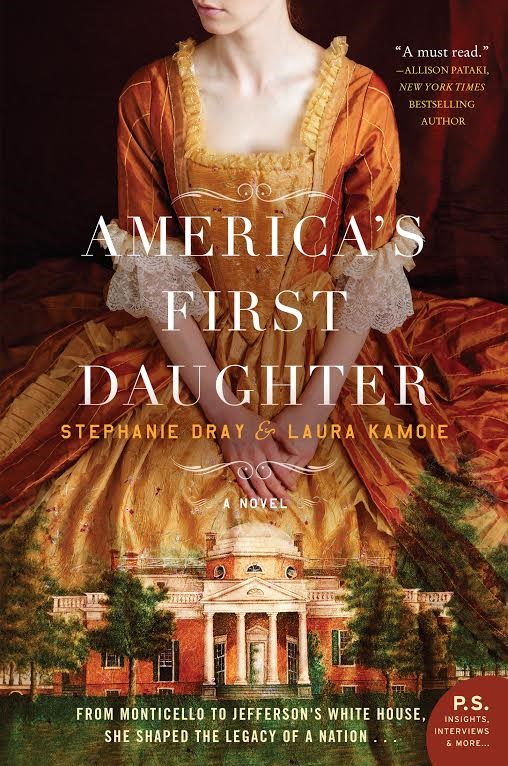
AMERICA’S FIRST DAUGHTER: Things That Didn’t Make It Into The Book (Part One) by Stephanie Dray and Laura Kamoie

Welcome to History Undressed, guest authors, Stephanie Dray and Laura Kamoie! Enjoy their post today on things that didn't make it into their new book: America's First Daughter!

AMERICA’S FIRST DAUGHTER: Things That Didn’t Make It Into The Book (Part One)

Patsy Jefferson’s Later Life

By Stephanie Dray and Laura Kamoie

Today we are absolutely thrilled to be celebrating the release of our new book, America’s First Daughter, which portrays the relationship between Martha “Patsy” Jefferson Randolph and her famous father, Thomas Jefferson, and explores the sacrifices Patsy made and the lies she told to protect him, his legacy, and the new nation he founded.

America’s First Daughter is more than six hundred pages long and we still couldn’t fit it all in, so as we mentioned in our author’s note, some very painful omissions were made. Thankfully, we can post about things that aren’t in the book, but that we think will are historically significant and will be interesting to readers.

Because we wanted to frame the novel with the Jefferson family’s letters--the writing, reading, editing and publishing of them, our novel ends in 1830, years before Martha “Patsy” Jefferson Randolph’s death. As a consequence, a number of things about her later life never made it into the book because they occurred after this date.

The Death Bed Denial

Among the things that happened after our novel ends include an event in the springtime of 1835, when an ailing Patsy Jefferson believed she was near death and called her children to her bedside. Patsy wanted to make a division of what was left of her property--including her human property--and she said she wanted to do it while her head was still “perfectly clear.”

She had a plan for dividing her cash, stocks, and items that had belonged to her father. She also had a plan for her slaves; she wished to emancipate two of the daughters of Burwell Colbert, who had been Jefferson’s personal butler and valet at the end of his life. Patsy also directed her children to give Sally Hemings, Betsy Hemings and the gardener, Wormley Hughes, “their time.” This was a method by which Virginians could free slaves without forcing them to leave the state, as was required under the law at the time. All three had lived in Virginia as free people since Jefferson’s death, but Patsy wanted this understood by her children.

And yet, she did not free all her slaves, nor did she forget her lifelong mission to protect her father’s reputation even at the expense of those who he’d held in bondage. We were struck by the fact that as her own mortal life came to a close, Patsy Jefferson’s mind was fixed on her father’s immortal legacy. Clearly, she remained worried about the Sally Hemings scandal until the very end.

She told her grown children that Jefferson’s farm records would prove that he and Sally Hemings were far apart when Sally’s son Eston (who was rumored to look very much like Jefferson) was born. Patsy told her sons to always remember this and defend the character of their grandfather.

In fact, Jefferson’s farm records weigh in favor of the proposition that he was at Monticello (and presumably near to Sally) within nine months of the birth of each of her children. And today most historians--as well as the Thomas Jefferson Foundation--believe that the weight of the historical evidence supports the idea that Jefferson fathered the children of Sally Hemings. If true--and we believe it is--it is simply not credible that his daughter did not know about it.

And if she knew, then Patsy Jefferson was the kind of person who was willing to lie to her own children with what she believed might be her very last breath.

To us, that spoke volumes about her, coloring every choice we made in the novel.

The Death of “Randolph of Roanoke”

Though Patsy and John Randolph were foes, his death presented her with a dilemma. In his last will, the colorful and acerbic politician who had fought with Patsy’s husband, her father, and even formed his own political party, formally emancipated his slaves, nearly four hundred in all. They weren’t just emancipated, but also given land in Ohio upon which to resettle. John’s heirs and assigns--Martha’s relations--urged her and her financially struggling children to join the lawsuit to void this will, keep the slaves in bondage, and divide “the plunder.”

Patsy said she would never support any effort to keep those slaves in bondage, and persuaded her children to follow her example. And as Virginian politics shifted away from anti-slavery sentiments to advocating slavery as a biblically condoned societal good, she and her children did not want to be part of a slave-holding society, and sought to leave, concluding that Virginia was “no longer a home for the family of Thomas Jefferson.”

But when it came to slavery, Patsy was susceptible to the same moral failings as her father, as yet another incident proves…

Martha Ann Colbert and the Whipping of Sally

The enslaved woman named Sally that is most famously associated with the Jeffersons is Sally Hemings. However, it’s a different Sally altogether who was at the receiving end of Patsy Jefferson’s discipline in 1833. The incident is notable because it’s the only documented instance of Patsy disciplining the enslaved human beings she said she felt “bound by the most sacred of all duties to protect.”

According to Patsy’s daughter, Cornelia, this enslaved girl named Sally was sent to a constable to be flogged after some infraction. But when she later stole a pair of stockings, the sixty-one year-old Martha Jefferson Randolph decided to take up the whip herself. “What disciplinarians we have turned out to be,” Cornelia wrote, adding that a Hemings relation judged the whipping to be “not enough” to change Sally’s behavior.

As earlier mentioned, in 1835, Patsy Jefferson thought she was dying. And having called her children together, she directed the emancipation of several slaves including Martha Ann Colbert. Poor fortune indeed for Martha Ann that Patsy did not actually die in 1835. The next year, as Patsy’s children began to disperse and ask for her financial help--presumably in the form of gifting them slaves--Patsy wrote that she had “no right to sacrifice the happiness of a fellow creature black or white.”

And yet, like her father, knowing that she didn’t have that right didn’t stop her. In the end, acknowledging it was “an evil” to separate this young woman from her family, Patsy agreed to give Martha Ann to her son, Lewis, who was moving to Arkansas. The ultimate fate of Martha Ann Colbert isn’t known--since Lewis died soon after--but it is clear evidence that like her father before her, in the crucible of financial difficulties, Patsy Jefferson put the interests of her white children ahead of moral principles. When she did so, perhaps she justified it as her father did when he wrote: “justice is on one scale, and self-preservation on the other.”

Stay tuned for more posts in this series of Things That Didn’t Make It Into The Book. And thanks for reading!

~Stephanie and Laura

About America’s First Daughter:

In a compelling, richly researched novel that draws from thousands of letters and original sources, bestselling authors Stephanie Dray and Laura Kamoie tell the fascinating, untold story of Thomas Jefferson’s eldest daughter, Martha “Patsy” Jefferson Randolph—a woman who kept the secrets of our most enigmatic founding father and shaped an American legacy.

From her earliest days, Patsy Jefferson knows that though her father loves his family dearly, his devotion to his country runs deeper still. As Thomas Jefferson’s oldest daughter, she becomes his helpmate, protector, and constant companion in the wake of her mother’s death, traveling with him when he becomes American minister to France.

It is in Paris, at the glittering court and among the first tumultuous days of revolution, that fifteen-year-old Patsy learns about her father’s troubling liaison with Sally Hemings, a slave girl her own age. Meanwhile, Patsy has fallen in love—with her father’s protégé William Short, a staunch abolitionist and ambitious diplomat. Torn between love, principles, and the bonds of family, Patsy questions whether she can choose a life as William’s wife and still be a devoted daughter.

Her choice will follow her in the years to come, to Virginia farmland, Monticello, and even the White House. And as scandal, tragedy, and poverty threaten her family, Patsy must decide how much she will sacrifice to protect her father's reputation, in the process defining not just his political legacy, but that of the nation he founded.

Advanced Praise for America’s First Daughter:

“America’s First Daughter brings a turbulent era to vivid life. All the conflicts and complexities of the Early Republic are mirrored in Patsy’s story. It’s breathlessly exciting and heartbreaking by turns-a personal and political page-turner.” (Donna Thorland, author of The Turncoat)

“Painstakingly researched, beautifully hewn, compulsively readable -- this enlightening literary journey takes us from Monticello to revolutionary Paris to the Jefferson White House, revealing remarkable historical details, dark family secrets, and bringing to life the colorful cast of characters who conceived of our new nation. A must read.” (Allison Pataki, New York Times bestselling author of The Accidental Empress)


About the Authors:


Stephanie Dray is an award-winning, bestselling and two-time RITA award nominated author of historical women’s fiction. Her critically acclaimed series about Cleopatra’s daughter has been translated into eight different languages and won NJRW's Golden Leaf. As Stephanie Draven, she is a national bestselling author of genre fiction and American-set historical women's fiction. She is a frequent panelist and presenter at national writing conventions and lives near the nation's capital. Before she became a novelist, she was a lawyer, a game designer, and a teacher. Now she uses the stories of women in history to inspire the young women of today.

Laura Kamoie has always been fascinated by the people, stories, and physical presence of the past, which led her to a lifetime of historical and archaeological study and training. She holds a doctoral degree in early American history from The College of William and Mary, published two non-fiction books on early America, and most recently held the position of Associate Professor of History at the U.S. Naval Academy before transitioning to a full-time career writing genre fiction as the New York Times bestselling author, Laura Kaye. Her debut historical novel, America's First Daughter, co-authored with Stephanie Dray, allowed her the exciting opportunity to combine her love of history with her passion for storytelling. Laura lives among the colonial charm of Annapolis, Maryland with her husband and two daughters.