Above painting: Louis Jean Francois - Mars and Venus an Allegory of Peace

Pages

***All photos accompanying posts are either owned by the author of said post or are in the public domain -- NOT the property of History Undressed. If you'd like to obtain permission to use a picture from a post, please contact the author of the post.***

Thursday, November 1, 2012

Margaret Mallory Talks About Researching Her Latest Scottish Romance


*All photos are the property
of the author, Margaret Mallory
Welcome back to History Undressed, guest author, Margaret Mallory! Today she's here giving us an inside view of the research behind her latest Scottish romance, THE WARRIOR, which has been met with rave reviews! Enjoy!

To research THE WARRIOR, I poured over books and articles, as I usually do. But the two things I did that made the biggest difference for my story was making some four-legged friends and listening to a song.

When I realized that I’d written five books without a single dog—not counting the brief appearance of that unpleasant one on Queen Margaret Tudor’s lap—I decided to include one in THE WARRIOR. Most breeds we know today did not exist in early 16th century Scotland, so I didn’t have many choices. Some variation of terrier was probably on the Isle of Skye in 1516, but a terrier didn’t seem like quite the right dog to pair with Duncan MacDonald, the most alpha of my alpha warriors.

I’d nearly settled on the Scottish Deerhound, a graceful hunter, when I came across its larger cousin, the Irish Wolfhound. According to the American Kennel Club, the wolfhound has a “commanding presence,” is “remarkable in combining power and swiftness,” and is “muscular, strong though gracefully built.” While fierce enough to fight wolves, this dog is also loyal, steadfast, and oh-so-handsome.

Laugh, but the more I read about the wolfhound, the more this dog seemed just like my hero. How fortuitous that my heroine is in Ireland in chapter 1. Clearly, this dog was meant to be in my book. I named him Sàr, a Gaelic word for warrior.

Because I’d never met a wolfhound, a friend took me to visit a woman in town who owns three. I fell in love instantly. These dogs were everything I’d read about and more. The second time I visited, one of the dogs had 12-week-old puppies. Research should always be this fun!

The owner assured me that these gentle giants could take down wolves and shared this expression that is used to describe them:  Gentle When Stoked, Fierce When Provoked.

That’s how I found a dog for my book. Now, for the musical research.

Through constant training, determination, and natural talent, Duncan MacDonald has become the most fearsome warrior in his clan and captain of his chieftain’s guard. Early on, I decided that such a tough hero needed an unexpected trait to add another dimension to his personality and reveal his heart. So I made this hardened warrior musical.

In the first two books of the series, Duncan showed this talent mostly by playing sad tunes on the six-hole whistle--a precursor of the tin or penny whistle—that he carries attached to a leather thong around his neck. I confess that in THE GUARDIAN I made a mistake—gasp!—by making his whistle metal. I’ve learned since that this would be extremely unlikely, so Duncan’s whistle is now made of bone.

Despite my gross error, Duncan’s whistle seemed to work, judging from the extremely positive reader mail I received about him. I was a wee bit worried, however, about handling Duncan’s musical talent when he took center stage in his own book. Clearly, Duncan would need more than a whistle. And I, alas, am utterly lacking in musical talent.

Regardless, I forged ahead and made my warrior one of those truly gifted musicians who can play almost any instrument he picks up. From his mother, he learned to play the harp. The harp was the Celtic instrument for centuries and was still played after the pipes became the symbolic instrument of the Highlands. I can’t tell you when the pipes became important, but it was probably sometime during the 1500’s that every chieftain worthy of the name had to have a piper.

A number of people in a Highland castle might know how to strum on a harp, to varying degrees, but having my hero play the pipes, even a little, seemed risky. As best I can tell, it was around the time of my books that piping families emerged, and their members spent years and years learning their craft.

The MacCrimmons were the most renowned of the piping families. To help his musical ability seem more credible, I gave Duncan a MacCrimmon piper as his maternal grandfather. (In my book, the MacCrimmons have started their famous piping school on Skye, but that probably happened later.) The MacCrimmons served as the hereditary pipers for my hero’s enemy clan, the MacLeods, which added intrigue to my plot.
I already had Duncan playing three instruments. I had no plans to make him a singer.

That changed the day I happened to listen to the words to the traditional song, Black is the Color of My True Love’s Hair. The description of the woman could have been written for Moira, my heroine, and the longing of the song reflected Duncan’s feelings for her perfectly. When I heard it, I knew Duncan not only had to sing, but that he had to sing this particular song if it was historically possible.

Fortunately, it was. I discovered that the song is from Appalachia, but it’s believed to have originated in Scotland. I listened to this beautiful, emotional song countless times, weeping over my laptop while writing poignant scenes in THE WARRIOR.

The second song I listened to endlessly for inspiration while writing this book was Gerard Butler singing Galway Girl, from the movie P.S. I Love You. I know Galway is in Ireland and the song isn’t nearly old enough, but Gerard helped me envision an alpha-warrior Scot who is even sexier and more manly when he sings.

I’d love to respond to questions or comments!  Tell me if you like the idea of a dog as a character or what kind of music you listen to for inspiration—or anything else. I’ll give away a signed copy of THE WARRIOR to one of the commenters.

~*~*~*~*~
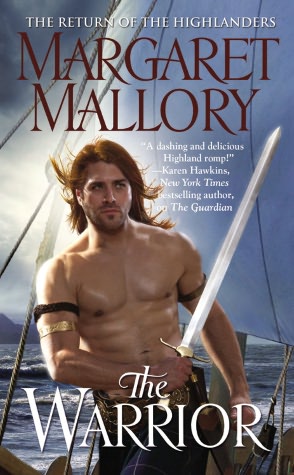
“4 ½ Stars! Top Pick!” RT Book Reviews

“THE WARRIOR is heartbreaking, filled with tension, breathtaking passion and nonstop adventure...A perfect romance…Superb storytelling!” 5 Blue Ribbons, Romance Junkies


THE RETURN OF THE HIGHLANDERS: BOOK 3

Four fearless warriors return to the Highlands to claim their lands and legacies. But all their trials on the battlefield can't prepare them for their greatest challenge yet: winning the hearts of four willful Scottish beauties.

STAR-CROSSED

From the Isle of Skye to the battlefields of France, Duncan MacDonald has never escaped the memory of the true love he left behind. Deemed unworthy of a chieftain's daughter, Duncan abandoned the lovely Moira to prove his worth in battle. Now, when called upon to rescue her from a rival clan, one thing is certain: Moira's pull on his heart is stronger than ever.

Bartered away in marriage to a violent man, Moira will do anything to ensure she and her son survive. When a rugged warrior arrives to save her, the desperate beauty thinks her prayers have been answered-until she realizes it's Duncan. The man who once broke her heart is now her only hope. Moira vows never again to give herself—or reveal her secrets—to the fierce warrior, but as they race across the sea, danger and desire draw them ever closer.

Visit Margaret at her Website for links to read the book and an excerpt!


Wednesday, October 31, 2012

Happy Halloween!

Happy Halloween!

In honor of this fascinating holiday steeped in historical tradition, I give you this video from the History Channel--History of the Holidays: Halloween!


Join me at the Reading Between the Wines blog for a Character Costume Party! Tons of giveaways!

Monday, October 29, 2012

Un-Civil Grounds - Paranormal Activity at U.S Civil War Prisons by Donna Dalton

Welcome to History Undressed, guest author Donna Dalton!  She's written a fascinating piece for us today on the Civil War. Enjoy!


Un-Civil Grounds - Paranormal Activity at U.S Civil War Prisons

by Donna Dalton 

While researching settings for my historical romance, THE REBEL WIFE, I took a field trip to the southern-most point of the state of Maryland where Point Lookout Union Prison once stood. It was a glorious late spring day. Short-wearing weather. Yet as I passed through the reconstructed gate and into the prison innards, a heavy sense of oppression overcame me. This flat, austere land had once imprisoned thousands of men. It had seen much suffering and many deaths.  Flanked by the Chesapeake Bay on one side and the Atlantic ocean on the other, the harsh winter months must have been pure hell for the sparsely clothed and starving inmates. Although I didn’t encounter any paranormal activity that day, I could see how departing life in such a wretched place could leave behind tormented souls.

I did a little research and discovered Point Lookout is considered to have one of the most haunted lighthouses in the country. The lighthouse sits at the very end of the peninsula. The most frequent sighting is of a gaunt ghost clothed in ragged, homespun clothing, running back and forth across the road. Other visitors have reported seeing a old woman on the beach, and some speculate she is looking for her gravestone. Paranormal researchers to the area have recorded over twenty-four different sounds and voices.

Other prison camps have reported paranormal activity as well. At the Confederate prison in Andersonville, Georgia, many visitors have heard eerie noises, including gunshots, marching, voices talking, and moaning. There’s a stench that people have smelled in the general area of the camp. One visitor was walking the grounds during twilight and spotted a strange figure walking ahead of him. A putrid odor permeated the air. The stranger and the odor vanished, but later, the man overheard a voice behind him talking about giving the last rites.

At Fort Delaware prison camp, in a restored and fully working officers’ kitchen, there have been reports of a female ghost that lingers around the pantry, hiding items stored there and calling people by name, telling them to get out. The officers’ quarters is reported to be haunted by several apparitions. A childlike ghost tugs on people’s clothing and its laughter can be heard. A woman’s ghost has tapped people on the shoulder and has touched them. Books fall from shelves by themselves and crystals hanging from a set of candlesticks move back and forth when there is no breeze to account for the movement.

While I have never personally meet with any apparitions, I believe they do exist, especially those souls who met their end during calamitous times like the U.S. Civil War. For those readers who find this period in American history fascinating, my latest book, THE REBEL WIFE, is set during the height of the war. The hero is a Yankee war correspondent on his way to Point Lookout to write an article about the prison. Louisa Carleton, a southern rebel, is also headed to there to try and free her imprisoned brother. Jack sees the world in black and white, while dyslexic Louisa sees everything in a distorted light. The joining of these two people cannot help but be filled with conflict and emotion.  You can read more about this story and how to purchase it on my website at www.donnadalton.net.


Wednesday, October 24, 2012

Historical Book Review: The Queen's Lady by Barbara Kyle

Today's historical book review of THE QUEEN'S LADY by Barbara Kyle was completed by History Undressed's ebook reviewer, Morgan Wyatt.

ABOUT THE BOOK...


London 1527. Set in the nerve-jangled court of Henry VIII during his battle with the Catholic church for a divorce, THE QUEEN’S LADY is the story of Honor Larke, a ward of King Henry’s chancellor, Sir Thomas More, and a lady-in-waiting to Henry’s first wife, Queen Catherine of Aragon. Forced to take sides in the religious extremism of the day, Honor fights to save the church’s victims from death at the stake, enlisting Richard Thornleigh, a rogue sea captain, in her missions of mercy, and finally risking her life to try to save Sir Thomas from the wrath of the king.


Available now in ebook and print!
Visit the Author's Website

MORGAN'S REVIEW...

The Queen’s Lady, a historical romance, by Barbara Kyle was published first in 2008 by Kensington. It is available in both paperback and e-Book version. The story starts on the May Day riots when apprentices are revolting against the rich foreigners. The apprentices loot and pillage the city under the watchful eyes of seven-year-old Honor. The young heroine not only witnesses the carnage, but describes it in detail to the number of criminals, what they stole, the men’s names, even can identify types of silver tableware since the experience is embedded so vividly in her memory.

Honor Larke is a motherless girl of some nobility, but has a father at war with the church. She watches her father excommunicated by vengeful priest because he won’t prepay for his confession and absolution before he dies. The priest isn’t satisfied to condemn the dying man to eternal damnation, but hatches a scheme to steal Honor’s birthright by his ability to read Latin. Talk about an argument for literacy.

Thomas More becomes Honor's guardian. This famous historical character is drawn as a self-serving, man of the cloth. More, plus the vengeful priest who would make the Mafia members look saintly, convince Honor to abandon her Catholic faith and help Lutherans.

This is about the part where I became confused and wondered if this were a romance or not? Honor shows interest in a married man whose wife mysteriously dies prompting her to propose two days after the wife’s death. This makes me wonder were men in such a short supply that you had to grab them when you could, or did the wife’s sudden death have some assistance?

There are no major characters besides Honor. No strong romantic male lead is involved in the tale, but a mediocre one shows up halfway through the tale.  Thomas More gets a bit of a feature role, but it is only an opportunity to drag the Catholic faith through the mud. Even as non-Catholic, I was amazed at lengths the author went to defame a religion and a standard-bearer of that faith. An excess of religion is more suitable for inspirational novels.

The Queen’s Lady has the feel of an older, classic historic romance with verbose prose that makes sure to use nine words when five would suffice. The settings are richly drawn with historical detail. Honor turns out to be a regular Polly Purebred, the heroine featured in melodramas. She is orphaned, kidnapped, raped, and denied her inheritance pretty much before the middle of the book.

When I first started reading the book, I thought another POV might be helpful, but soon discovered no other character lasts long enough to provide an additional POV. The use of another POV might also result in the reader being sympathetic to that character, as opposed to Honor. I did have issues with a seven year old telling me items she’d have no reference of, and being able to express herself so eloquently. The illiterate Honor manages to understand a dying man speaking Italian, when the poor child doesn’t even know what a foreigner is. As a mother, I wondered why a seven-year-old child is roaming the rough streets of London when the household has adults who could fetch the missing Ralph home.

The Queen’s Lady was not the book for me, but it does not mean others would not like it, especially those who like old style romances. Many have liked it evidenced by online reviews and likes on Amazon. The blurb by Susan Wiggs on the front confused me because I thought it would be similar to Susan’s work. It isn’t. I found The Queen’s Lady weighted down with religious rhetoric; isn’t that what non-fiction is for? Want to learn a little more about Henry the Eighth’s first wife, Katherine of Aragon, and then I believe you’d enjoy this tale too, along with classic romance fans.

Tuesday, October 23, 2012

Hidden History – Women of the Border Reivers by Blythe Gifford

Welcome back to History Undressed, guest author Blythe Gifford! Today she's written a fascinating piece for us about Scotland and England. Enjoy!

Author Blythe Gifford
Photo by
 Jennifer Girard

Hidden History – Women of the Border Reivers

 by Blythe Gifford

Most of us nod wisely and cluck our tongues about the paucity of information about women in history  Unknown, unsung, unreported, it is always a challenge to discover enough about how real women lived to spin an authentic historical tale.
But I had no idea how true this was until I started writing in the era of the Border Reivers.
For those who don’t know, the Reivers (pronounced Reevers) were basically raiders on both sides of the Scottish/English border.  Loyal to family above king, these folks had feuds that rivaled the famous Hatfields and McCoys  They were beyond the law of either government, and usually even beyond the reach of the special Border Laws that were developed in a joint English-Scottish effort to bring order from the chaos.  For nearly 300 years (roughly 1300-1600), they “made a living” by stealing from others, or, alternately, by collecting “blackmail” from those who wanted to be left alone.
My new historical romance trilogy features the three siblings of a reiving family I call the Brunson clan.  I started to research the lives of women of the era, but information was so scarce about this macho society that I could barely find any information about how they dressed, though there are pictures aplenty of what the men donned to ride a raid.
The first story a researcher always finds about the women of the Borders is this:  When the larder ran low, the woman of the house would bring her man a set of spurs instead of supper.  That meant it was time for him to go “riding” again. 
The second thing I found was a prevailing opinion (from the English side of the border, to be fair) that Scottish women were “comely,” but “not distinguished by their chastity.” 
Hints, but not much to go on.
Beyond stealing sheep and cattle, there was arson and even murder aplenty on the Borders, and many women were left widowed and orphaned.  Later written histories claim that even women and children were not safe from atrocities during these raids.  Yet there’s a tension in the stories of this culture between the ones that claim Reivers honored women and preferred not to kill and the ones that label them vicious and cruel and ruthless. 

Modern litanies of the Reivers’ sins typically list rape among them.  In actual historic accounts, however, I was unable to find a specific report of one in the history.  (I am not alone in this.  The book Government, religion, and society in northern England, 1000-1700 mentions the “notable absence” of rape from the list of transgressions.)
Is this because it did not happen, or because women did not make it public?  The answer, as so much of women’s history, is hidden.  Yet there was a law passed by the Scottish Parliament in 1525 which gave the king’s officers the right to punish “particular faults and crimes that occur.”  On the list was “ravishing of women.”  A tantalizing clue.
Yet amidst the harsh reality, I discovered softness and beauty.  This was not a society that had leisure for art and culture, but the Border Ballads, rediscovered and popularized by Sir Walter Scott at the turn of the 19th century, remain hauntingly beautiful today. 

In his book FOLK SONG IN ENGLAND, A.L. Lloyd writes of the border dwellers that “they prized a poem almost as much as plunder.”  The narrative songs they created tell rip-roaring stories of war and love, like the one that begins:

My love he built me a bonny bower,
And clad it a' wi' lilye flour;
A brawer bower ye ne'er did see,
Than my true love he built for me.


Alas, the title of the ballad is “The Lament of the Border Widow,” and the final verse goes like this:

Nae living man I'll love again,
Since that my lovely knight is slain;
Wi' ae lock of his yellow hair
I'll chain my heart for evermair.


So where is a romance writer to find a happy ending?  Well, it turns out that love conquered all during the era of the Reivers, just as it always has. 
It seems that there was a law forbidding marriage across the border (upon penalty of death) unless one had special permission.  This was intended to make it easier for the kings to keep control of the population by preventing marriage/family ties that might dilute national allegiance.
Despite the best efforts, not only did such marriages occur, they were a near epidemic, to the extent that in some regions, the list of those that did NOT have cross border marriages was shorter than the list of those that did.
So in the end, I had a head full of ideas for my trilogy, confident that no matter how difficult the existence or strict the prohibition, men and women fall in love and get married.  There was all the validation I needed to write Border Reiver romance.
Cover Art used by arrangement with Harlequin
 Enterprises Limited.
All rights reserved. ®and T are trademarks of
Harlequin Enterprises Limited and/or its
affiliated companies, used under license.
Copyright 2012
What do you most wonder about the lives of women in history?  Leave a comment and one lucky person will win a copy of RETURN OF THE BORDER WARRIOR, first book in The Brunson Clan trilogy.  Here’s a brief description:

WORD IN THE ROYAL COURT HAS SPREAD THAT THE WILD SCOTTISH BORDERS ARE TOO UNRULY. UPON THE KING'S COMMAND, JOHN BRUNSON MUST RETURN HOME...

Once part of a powerful border clan, John has not set sight on the Brunson stone tower in years. With failure never an option, he must persuade his family to honour the King’s call for peace.

To succeed, John knows winning over the daughter of an allied family, Cate Gilnock, holds the key. But this intriguing beauty is beyond the powers of flattery and seduction. Instead, the painful vulnerability hidden behind her spirited eyes calls out to John as he is inexorably drawn back into the warrior Brunson clan…
Harlequin HistoricalsTM
ISBN#978-0-373-29714-6


Blythe Gifford has been known for medieval romances featuring characters born on the wrong side of the royal blanket. Now, she’s launching a trilogy set on the turbulent Scottish Borders if the early Tudor era, starting with RETURN OF THE BORDER WARRIOR a November release from the Harlequin Historical line. CAPTIVE OF THE BORDER LORD will follow in January 2013, and TAKEN BY THE BORDER REBEL in March 2013.  The Chicago Tribune has called her work "the perfect balance between history and romance." She loves to have visitors at www.blythegifford.com,"thumbs up" at www.facebook.com/BlytheGifford, "tweeps" at www.twitter.com/BlytheGifford, and followers at www.pinterest.com/BlytheGifford. You can also find her on Goodreads.

Monday, October 22, 2012

Historical Romance Review: Captured Heart by Heather McCollum

Today's historical romance review of Heather McCollum's book CAPTURED HEART was written by Emma Westport!

ABOUT THE BOOK:


Fleeing with only her bow, horse, enormous pet wolf, and the cryptic clues hidden in her mother’s medicine journal, healer Meg Boswell gallops north towards freedom, running from the man who falsely accused her mother of witchcraft. Cursed with magical healing abilities, Meg knows that if she’s captured, she will die like her mother—atop a blazing witch’s pyre.

Winter winds rip across the Highlands, pressing Chief Caden Macbain forward in his desperate plan to save his clan. He’s not above using an innocent woman to bargain for peace if it keeps his clan from starving. But Meg isn’t who Caden thinks she is, and when she kills a man to save the clan, he must choose between duty and her life. For although he captured her to force a peace, Meg's strength and courage have captured Caden's heart.

Published with Entangled Select, Sept. 2012
Available in print and ebook


EMMA'S REVIEW:


Set in the Highlands in the late 16th century, Captured Heart offers all that is best in historical romance—adventure, love and a happy ending brushed by magic.

Meg Boswell is a healer, a young woman haunted by her mother’s death.  Isabel Boswell was betrayed by her husband, Rowland Boswell, and burned as a witch.   Now Boswell, a rich, powerful man, wants to force a marriage on his daughter and he’s not above threatening Meg with charges of witchcraft if she tries to refuse.  Meg flees to the Highlands, hoping to find shelter with her mother’s sister and to prove her father’s treason.

Caden Macbain is chief of the Macbain’s, a Highland clan facing a rough winter.  Their crops have been burned, their cattle stolen and people will  certainly starve if Caden can’t end a century old feud.  He hopes to do that by kidnapping Meg Boswell and using her to negotiate a truce with the warring Munros.

Threatened by petty jealousies, warring clans and the competing claims of kings and religions, Meg and Caden struggle to save themselves and those they love from disaster.  Between Caden’s strength and Meg’s magic they are all but unstoppable.

Captured Heart will draw you in and leave you enchanted.  When it comes to romance and adventure, it definitely delivers.  Well worth the read.


Tuesday, October 16, 2012

Julie Peakman's New Book: Mighty Lewd Books


At Last! Gasp!

The paperback of Julie Peakman’s

Mighty Lewd Books
  
Published by Palgrave Macmillan October 2012.

Now considered a classic amongst scholars of eighteenth century and the history of pornography, Mighty Lewd Books provides a radical new approach to the study of sexuality in an in-depth investigation of the development of pornography. Through the examination of more than 500 pieces of British erotica, it looks at sex as seen in culture, religion and medicine throughout the long eighteenth-century.

A new form of flagellation pornography burst to the fore in the 1770s when erotic fiction became littered with whipping scenarios. Prior to this, English erotica had included a particular style of bawdy material marked by euphemisms and double entendres. Erotic poems, salacious prints and obscene satires were sold in London coffee-shops, in taverns, on street corners and in various book shops along the Strand and in Covent Garden. The underworld of booksellers and distributors are explored through trial records and witness depositions. This book also explores popular images in erotica; female flagellants whipping their submissive charges; depraved monks corrupting innocent nuns; libertine rascals seducing young virgins; and rakes carousing with their whores. Using the evidence of erotica, and taking a feminist approach within a framework of gender history, this book challenges the traditional view that women were generally seen as sexually passive.

About the Author: Julie Peakman is a historian, author and broadcaster who is internationally renowned for her work on the history of sexuality. Her books include Lascivious Bodies: A Sexual History of the Eighteenth Century; a six-volume edition of A Cultural History of Sexuality and the edited collection Sexual Perversion 1670–1890. Since its first publication her ground-breaking book Mighty Lewd Books has become essential reading for anyone interested in eighteenth century erotica and the history of sexuality. She lives in London and on the Greek island of Leros.

Reviews:
 ‘This . . . fascinating and intelligent survey shows how an explosion of obscene literature
immediately followed the wild success of pioneering (but largely non-pornographic) fictions by Defoe, Swift, Richardson and their imitators . . . Porn’s strongest selling points were that it was sexy, unrespectable and forbidden, of course, but Julie Peakman shows that it had other attributes, not always connected directly with sex. It popularised new scientific ideas in botany, anatomy and electricity. It stoked the fires of anti-Catholicism with its lecherous monks and nuns, and it encompassed radical ideas in politics.’
—      Financial Times


‘ . . . fascinating book . . . well-written and researched . . . this book offers intriguing new insights into a hidden area of gender history, challenging many preconceptions about the c.18th century.’—      BBC History Magazine