Above painting: Louis Jean Francois - Mars and Venus an Allegory of Peace

Pages

***All photos accompanying posts are either owned by the author of said post or are in the public domain -- NOT the property of History Undressed. If you'd like to obtain permission to use a picture from a post, please contact the author of the post.***
Showing posts with label Margaret Mallory. Show all posts

Thursday, November 1, 2012

Margaret Mallory Talks About Researching Her Latest Scottish Romance


*All photos are the property
of the author, Margaret Mallory
Welcome back to History Undressed, guest author, Margaret Mallory! Today she's here giving us an inside view of the research behind her latest Scottish romance, THE WARRIOR, which has been met with rave reviews! Enjoy!

To research THE WARRIOR, I poured over books and articles, as I usually do. But the two things I did that made the biggest difference for my story was making some four-legged friends and listening to a song.

When I realized that I’d written five books without a single dog—not counting the brief appearance of that unpleasant one on Queen Margaret Tudor’s lap—I decided to include one in THE WARRIOR. Most breeds we know today did not exist in early 16th century Scotland, so I didn’t have many choices. Some variation of terrier was probably on the Isle of Skye in 1516, but a terrier didn’t seem like quite the right dog to pair with Duncan MacDonald, the most alpha of my alpha warriors.

I’d nearly settled on the Scottish Deerhound, a graceful hunter, when I came across its larger cousin, the Irish Wolfhound. According to the American Kennel Club, the wolfhound has a “commanding presence,” is “remarkable in combining power and swiftness,” and is “muscular, strong though gracefully built.” While fierce enough to fight wolves, this dog is also loyal, steadfast, and oh-so-handsome.

Laugh, but the more I read about the wolfhound, the more this dog seemed just like my hero. How fortuitous that my heroine is in Ireland in chapter 1. Clearly, this dog was meant to be in my book. I named him Sàr, a Gaelic word for warrior.

Because I’d never met a wolfhound, a friend took me to visit a woman in town who owns three. I fell in love instantly. These dogs were everything I’d read about and more. The second time I visited, one of the dogs had 12-week-old puppies. Research should always be this fun!

The owner assured me that these gentle giants could take down wolves and shared this expression that is used to describe them:  Gentle When Stoked, Fierce When Provoked.

That’s how I found a dog for my book. Now, for the musical research.

Through constant training, determination, and natural talent, Duncan MacDonald has become the most fearsome warrior in his clan and captain of his chieftain’s guard. Early on, I decided that such a tough hero needed an unexpected trait to add another dimension to his personality and reveal his heart. So I made this hardened warrior musical.

In the first two books of the series, Duncan showed this talent mostly by playing sad tunes on the six-hole whistle--a precursor of the tin or penny whistle—that he carries attached to a leather thong around his neck. I confess that in THE GUARDIAN I made a mistake—gasp!—by making his whistle metal. I’ve learned since that this would be extremely unlikely, so Duncan’s whistle is now made of bone.

Despite my gross error, Duncan’s whistle seemed to work, judging from the extremely positive reader mail I received about him. I was a wee bit worried, however, about handling Duncan’s musical talent when he took center stage in his own book. Clearly, Duncan would need more than a whistle. And I, alas, am utterly lacking in musical talent.

Regardless, I forged ahead and made my warrior one of those truly gifted musicians who can play almost any instrument he picks up. From his mother, he learned to play the harp. The harp was the Celtic instrument for centuries and was still played after the pipes became the symbolic instrument of the Highlands. I can’t tell you when the pipes became important, but it was probably sometime during the 1500’s that every chieftain worthy of the name had to have a piper.

A number of people in a Highland castle might know how to strum on a harp, to varying degrees, but having my hero play the pipes, even a little, seemed risky. As best I can tell, it was around the time of my books that piping families emerged, and their members spent years and years learning their craft.

The MacCrimmons were the most renowned of the piping families. To help his musical ability seem more credible, I gave Duncan a MacCrimmon piper as his maternal grandfather. (In my book, the MacCrimmons have started their famous piping school on Skye, but that probably happened later.) The MacCrimmons served as the hereditary pipers for my hero’s enemy clan, the MacLeods, which added intrigue to my plot.
I already had Duncan playing three instruments. I had no plans to make him a singer.

That changed the day I happened to listen to the words to the traditional song, Black is the Color of My True Love’s Hair. The description of the woman could have been written for Moira, my heroine, and the longing of the song reflected Duncan’s feelings for her perfectly. When I heard it, I knew Duncan not only had to sing, but that he had to sing this particular song if it was historically possible.

Fortunately, it was. I discovered that the song is from Appalachia, but it’s believed to have originated in Scotland. I listened to this beautiful, emotional song countless times, weeping over my laptop while writing poignant scenes in THE WARRIOR.

The second song I listened to endlessly for inspiration while writing this book was Gerard Butler singing Galway Girl, from the movie P.S. I Love You. I know Galway is in Ireland and the song isn’t nearly old enough, but Gerard helped me envision an alpha-warrior Scot who is even sexier and more manly when he sings.

I’d love to respond to questions or comments!  Tell me if you like the idea of a dog as a character or what kind of music you listen to for inspiration—or anything else. I’ll give away a signed copy of THE WARRIOR to one of the commenters.

~*~*~*~*~
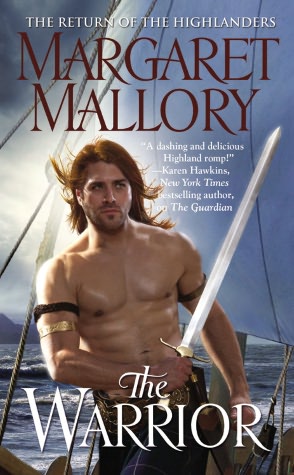
“4 ½ Stars! Top Pick!” RT Book Reviews

“THE WARRIOR is heartbreaking, filled with tension, breathtaking passion and nonstop adventure...A perfect romance…Superb storytelling!” 5 Blue Ribbons, Romance Junkies


THE RETURN OF THE HIGHLANDERS: BOOK 3

Four fearless warriors return to the Highlands to claim their lands and legacies. But all their trials on the battlefield can't prepare them for their greatest challenge yet: winning the hearts of four willful Scottish beauties.

STAR-CROSSED

From the Isle of Skye to the battlefields of France, Duncan MacDonald has never escaped the memory of the true love he left behind. Deemed unworthy of a chieftain's daughter, Duncan abandoned the lovely Moira to prove his worth in battle. Now, when called upon to rescue her from a rival clan, one thing is certain: Moira's pull on his heart is stronger than ever.

Bartered away in marriage to a violent man, Moira will do anything to ensure she and her son survive. When a rugged warrior arrives to save her, the desperate beauty thinks her prayers have been answered-until she realizes it's Duncan. The man who once broke her heart is now her only hope. Moira vows never again to give herself—or reveal her secrets—to the fierce warrior, but as they race across the sea, danger and desire draw them ever closer.

Visit Margaret at her Website for links to read the book and an excerpt!


Tuesday, November 1, 2011

Marriage in the Highlands in the Early 1500's by Margaret Mallory

Welcome back to History Undressed, Margaret Mallory, the talented author of medieval and Scottish romance! Today she is going to tantalize us with talks of marriage! Read on, and don't forget to comment for a chance to win a copy of her new release!

Marriage in the Highlands in the Early 1500’s*
Margaret Mallory

Dunscaith, home of the Chieftain of the MacDonalds of Sleat
The most surprising thing I learned in my research for my THE RETURN OF THE HIGHLANDERS series was about the marriage practices of Highlanders in the Western Isles, particularly the chieftains, at that time my books take place. 

In the early 1500’s, these Gaelic-speaking Highlanders maintained their old Celtic customs alongside their Christian beliefs. Priests were not necessary to make a marriage, which was fortunate since priests were few and far between in the Highlands at this time. In Celtic secular marriage, it was common for couples to enter a trial marriage. At the end of a year, either party could leave the marriage. If the couple decided to stick with it, they could have their marriage blessed at the same time their first child was christened when the priest made his rounds.  Children born of these trial marriages were considered legitimate, and men generally claimed children born outside of marriage as well.  Divorce was permitted by either party on fairly loose grounds.

Chieftains, who were more than kings to their clans, disregarded edicts from Rome as freely as they ignored edits from the Crown.  For them, marriage was a means of making an alliance with another clan—and they changed alliances all the time.  Henry VIII had nothing on some of these chieftains when it came to multiple wives, though a chieftain could simply “set aside” a wife, rather than look for an excuse to have her killed.

Cawdor Castle
The chieftains did not ignore the Church rules entirely, but Rome was a long way away so they generally followed the principle that it was better to ask forgiveness than permission. Though a chieftain might seek an annulment, he was unlikely to wait the two or three years to get an answer from Rome before taking a new wife.  The petition for annulment was often based on the marriage being in violation of the rules of consanguinity, though everyone had been well aware of the issue at the time of the marriage.

As might be expected, a clan chieftain’s serial (and sometimes concurrent) marriages did not always lead to family harmony or good relations with other clans. The MacDonalds of Sleat, the clan of my fictional heroes, had their share of such conflict.

Hugh (Uisdean), the first MacDonald of Sleat and the grandfather of my fictional character Connor, was one of three sons that Alexander, the third Lord of the Isles, had by different women. Despite being admonished by the pope himself for putting away his true wife and “adhering” to Hugh’s beautiful and highborn mother, Alexander refused to part with her. His half-sons, however, got along well.

Hugh had six sons by six different women, all from prominent families. Unfortunately, his sons did not get along as well as Hugh had with his half-brothers. In fact, Hugh’s first son hated his half-brothers so much that upon his death he turned the clan’s lands over to the Crown to keep the others from inheriting them. Though later chieftains held onto the lands, their lack of legal title caused the clan problems for years. Two of Hugh’s other sons were murdered by their half-brothers, and another was murdered by Hugh’s grandsons. 

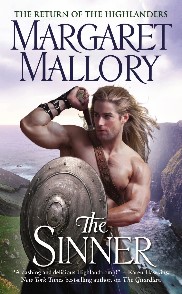
This family strife plays an important role in all four books in THE RETURN OF THE HIGHLANDERS. In THE SINNER, I also included as secondary characters two couples who were wed in order to make alliances between their respective clans—with wildly differing results.

Margaret Mallory at Eilean Donan
I drew on a well-known incident involving the Maclean chieftain, Lachlan Cattanach (Shaggy), and his wife Catherine, whose father and then brother were chieftains of the powerful Campbell clan. I won’t say here what happened, but when Shaggy was found murdered in bed on a visit to Edinburgh some years later, everyone assumed it was done by a Campbell in retribution.

Catherine’s brother John had better luck in marriage. When the Thane of Cawdor died leaving his baby daughter Muriel as his sole heir, clan chieftains all over the Highlands hoped to arrange a match that would result in one of their sons becoming the next Thane of Cawdor one day. When Muriel was still a toddler, the Campbell chieftain preempted the others by having his men snatch Muriel when she was outside the walls of Cawdor Castle taking in the fresh air with her nursemaid. Muriel was raised in the Campbell chieftain’s household and married to John as soon as she reached twelve, the age of consent. By all reports, this marriage, which was made solely for the purpose of gaining lands and wealth for the Campbells, was a very happy one.

Then as now, some marriages turn out well despite how they started.

* My primary source is “Marriage, Concubinage and Divorce in Gaelic Scotland,” by David Sellar, from Volume 51 of the Transactions of the Gaelic Society of Inverness. (Thanks to Sharron Gunn for referring me to the article.) I also found supporting information in clan histories from numerous sources.

~~~

I hope you’ll enjoy the slide show I put together of photos I took of some of the castles & other settings that appear in THE SINNER. To see the show, click here , then click on “show info” on the upper right for descriptions.

For Book Group Discussion Questions, blurbs, excerpts, and other information relating to my books, please visit my website: www.MargaretMallory.com.

I’d love to respond to your comments or questions! I’ll give away a signed copy of THE SINNER to one of the commenters.
*~*~*~*

THE RETURN OF THE HIGHLANDERS: BOOK 2


Four fearless warriors return to the Highlands to claim their lands and legacies. But all their trials on the battlefield can't prepare them for their greatest challenge yet: winning the hearts of four willful Scottish beauties.


IRRESISTIBLE DESIRE

Alex MacDonald is known for his skill as a warrior, his prowess with women, and his vow to never take a wife. But now his chieftain has asked him to make the ultimate sacrifice: wed Glynis MacNeil, a lass famed throughout the Highlands for her exquisite beauty—and defiant ways.
Familiar with heartbreak, Glynis refuses to fall for another handsome scoundrel. Yet when Alex's past sins force an unlikely union, Glynis gives in to temptation and becomes his wife. Will their newfound passion be strong enough to fight the enemy that threatens their home, their clan, and their very lives?

Wednesday, April 27, 2011

Guest Author, Margaret Mallory on SCOTLAND, 1513: From the Golden Time To Chaos

I am super excited today to introduce you all to our guest author, Margaret Mallory. Margaret is a 2010 RITA Finalist for her book, Knight of Pleasure, the second book in her England-set medieval series ALL THE KING'S MEN. But today, she's here to tantalize us with a bit of Scottish history (and a girl after my own heart since her post also happens to be about the Tudors!) and her NEW Scottish romance series--which I CAN'T WAIT to read! I had the pleasure of meeting Margaret in person last year at the RWA National Conference, as well as enjoying membership with her through Celtic Hearts Romance Writers and Hearts Through History, she is sweet, funny and smart and I look forward to reading her work for many years to come! So, without further ado, I give you Margarget!

SCOTLAND, 1513: FROM GOLDEN TIME TO CHAOS
by Margaret Mallory


My new Scottish series, THE RETURN OF THE HIGHLANDERS, takes place during the chaotic aftermath of Scotland’s crushing defeat at the Battle of Flodden.
James IV
What a difference a day makes. In this case, that day was September 9, 1513, the day the Scots were defeated by the English at Flodden.

Before the Battle of Flodden, Scotland seemed to be on the verge of a golden age. King James IV fostered the growth of universities, supported musicians and poets, and built palaces that rivaled those on the continent.

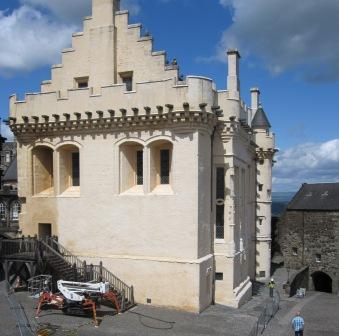
The Great Hall at Stirling Castle

The king, who learned to speak Gaelic, even gained the allegiance of the usually rebellious Highland chieftains. For a time, he also achieved “Perpetual Peace” with England by his marriage to Margaret Tudor, Henry VII daughter, in a union hailed as the Thistle and the Rose. Peace, perpetual or otherwise, proved difficult to maintain with Margaret’s aggressive, younger brother, Henry VIII. When France called on Scotland’s help in fighting the English, James IV honored the Auld Alliance and marched into northern England with perhaps 30,000 men.


Margaret Tudor
Henry VIII - 1509
The king led the Scots to a crushing defeat at the Battle of Flodden in Northumberland. Thousands of Scots died in the battle. The king, who foolishly put himself in the thick of the battle as if he were an ordinary soldier, was among the many, many dead. His body was so mutilated that there rumors for years that the body was not his and that the king had escaped.

Unfortunately for Scotland, the king left a seventeen-month-old babe as heir to the throne. Pro-French and pro-English factions vied for power, and clan chieftains saw an opportunity to increase their lands and influence.

The young and handsome Douglas chieftain, the Earl of Angus, charmed his way into the queen’s bed almost before the king’s body was cold. The fact that Margaret Tudor was pregnant with the dead king’s child did not appear to give either of them much pause.

Archibald Douglas, Earl of Angus
My hero and heroine in THE GUARDIAN, Book 1 of THE RETURN OF THE HIGHLANDERS, meet up with this dangerous pair of lovers on a trip to Stirling Castle.

Douglas overplayed his hand when he married Margaret. The Council was leery of having their enemy’s sister as regent and was glad for an excuse to replace her with the Duke of Albany, a Stewart who was raised in France. Margaret, however, refused to hand over the royal children until Albany laid siege to Stirling Castle.


Margaret Tudor Defying Parliament
A number of Highlander chieftains also died at Flodden, although there are conflicting stories as to how many and which ones were killed in the battle. This sudden change in the leadership of several clans added another layer of volatility, shifting alliances, and violence. In addition, the lack of a strong king led some of the Highland clans to rise up in rebellion again.

James IV was a Renaissance man, ahead of his time. In addition to supporting education, music, and new architecture, he unified his fractious country, skillfully negotiated European politics, and brought a period of relative peace to Scotland.

The four heroes of my RETURN OF THE HIGHLANDERS series left for France five years before the battle that changed everything. As soon as they hear the news of the Scot’s devastating loss to Henry VIII’s forces at Flodden, they hurry home to help their clan through the troubled times ahead.

And troubled times they were.

*****

Visit Margaret Mallory at http://www.margaretmallory.com/.  Leave a comment for your chance to win a signed copy of Ms. Mallory's new release: THE GUARDIAN!!!

THE RETURN OF THE HIGHLANDERS: BOOK I


Four fearless warriors return to the Highlands to claim their lands and legacies. But all their trials on the battlefield can't prepare them for their greatest challenge yet: winning the hearts of four willful Scottish beauties.

PASSION IGNITED

After years of fighting abroad, Ian MacDonald comes home to find his clan in peril. To save his kin, he must right the wrongs from his past . . . and claim the bride he's long resisted.

As a young lass, Sìleas depended on Ian to play her knight in shining armor. But when his rescue attempt compromised her virtue, Ian was forced to marry against his wishes. Five years later, Sìleas has grown from an awkward girl into an independent beauty who knows she deserves better than the reluctant husband who preferred war to his wife. Now this devilishly handsome Highlander is finally falling in love. He wants a second chance with Sìleas - and he won't take no for an answer.


__

Photos courtesy of Wikipedia, with the exception for the photo of The Great Hall, which was taken by the author, the author's photo, and the cover picture.