Above painting: Louis Jean Francois - Mars and Venus an Allegory of Peace

Pages

***All photos accompanying posts are either owned by the author of said post or are in the public domain -- NOT the property of History Undressed. If you'd like to obtain permission to use a picture from a post, please contact the author of the post.***

Friday, November 15, 2013

A Real-life Hero’s Profile From the First World War by Julie Rowe


Welcome to History Undressed, guest author, Julie Rowe! We're happy to host Ms. Rowe during her Aiding the Enemy virtual tour! Now onto a fascinating piece...

A Real-life Hero’s Profile from the First World War

by Julie Rowe

Former President Theodore Roosevelt called this man one of the “five bravest Americans” to serve in World War I.

Henry Johnson, the first American private to be awarded the Croix du Guerre, France’s highest military honor, in the First World War – was 5”4 and weighed 130 lbs. He was a porter at a train station in New York before he enlisted in the all-black 15th New York National Guard Regiment, renamed the 369th Infantry Regiment upon shipping out to France.

Henry and he fellow Harlem Hellraisers as many called them were poorly trained and worked at first at menial jobs such as latrine digging and unloading ships. The French army was short of men, however, so the Hellraisers were lent to them. They were given French helmets, weapons and a few useful words then put on sentry duty.

On Henry’s first night as a sentry, at about two am, a German raiding party made its way through the barbed wire. Henry and fellow Hellraiser Needham Roberts were stationed in a forward fox hole and heard their wire cutters. They began throwing grenades at the Germans. Return fire was fierce and Needham was wounded bad enough that he couldn’t do much more than hand Henry grenades. Henry was also wounded, but not as bad as his friend. When they ran out of grenades, Henry fired at the Germans until his rifle jammed. By this time the Germans were in their fox hole and were attempting to cart Needham off. Henry beat at them with the butt of his rifle until it broke. Then he pulled out his American bolo knife and hacked and slashed until the Germans dropped Needham and retreated. By then Henry had been injured several more times.

Dawn revealed the extent of the fight. Henry had killed four German soldiers outright and injured 10 to 20 more.


Giveaway!! Leave a comment with your email address for you chance to win one eBook of Aiding the Enemy + $10 Gift Card to an eRetailer of the winner's choice.  Open internationally.

About AIDING THE ENEMY

Publication Date: October 7, 2013
Carina Press
eBook
ASIN: B00E1UY67I

Book three of War Girls

German-occupied Brussels, Belgium
December 1915

Rose Culver is in grave danger. For months the Red Cross head nurse has been aiding Allied soldiers caught behind enemy lines, helping them flee into neutral Netherlands. It's only a matter of time until she's caught. Which makes it the wrong time to fall in love with a handsome German military doctor as devoted to the sanctity of human life as she is.

The Great War has caused Dr. Herman Geoff to question everything he once believed. He knows Rose has been hiding British soldiers in her hospital—he's even treated some of them, refusing to go against his own Hippocratic oath. As a doctor, he admires Rose's skill and conviction. As a man, he can no longer deny his attraction to her. But when Rose is arrested for treason, Herman must choose between love for her and duty to his country...

For more tales of love and war, download Saving the Rifleman and Enticing the Spymaster, available now!

About the Author

Julie Rowe’s first career as a medical lab technologist in Canada took her to the North West Territories and northern Alberta, where she still resides. She loves to include medical details in her romance novels, but admits she’ll never be able to write about all her medical experiences because, “No one would believe them!”. In addition to writing contemporary and historical medical romance, and fun romantic suspense for Entangled Publishing and Carina Press, Julie has a short story in the Mammoth Book of ER Romance (releasing Sept 15, 2013). Her book SAVING THE RIFLEMAN (book #1 WAR GIRLS) won the novella category of the Gayle Wilson Award of Excellence. Her writing has also appeared in several magazines such as Romantic Times Magazine, Today’s Parent, and Romantic Times Magazine.

For more information please visit Julie Rowe's website.  You can also find her on Facebook and Twitter.

For more chances to win, check out the other tour stops on the Aiding the Enemy Blog Tour!

Thursday, November 14, 2013

All About the Clothes by Janet Mullany

Welcome back to History Undressed, my dear friend Janet Mullany! I love her work and I think you will find her post today to be rather entertaining. Enjoy!

ALL ABOUT THE CLOTHES

by Janet Mullany

1790-1800 Men's Clothes
Victoria and Albert Museum Collection
Given by Messrs Harrods Ltd.
Thanks so much for having me visit, Eliza! It’s a pleasure to be here.

Ask any writer of historical fiction what drew them to their chosen genre, and sooner or later they’ll reveal the ugly truth: it’s the clothes. I can talk for hours about Georgian servants or the English abolition movement, but eventually I slow down and blurt out “And the tight pants.”

Yes, the tight pants, the shirts with the mancleavage reveal, the boots, and so on. All that starched white linen and other wonderful fabrics, wool, silks, satins, velvets, netting, knits. Women’s clothing of the Georgian-Regency period was comfortable, sparse—gown, petticoat, corset, shift—and the corsetry supported but did not restrict. It’s enough to make fetishists of us all. The stockings, however, are a bit of a disappointment—imagine a long tube sock that would slide down unless tied in place. The concept of sexy underwear did not exist. It was strictly practical, made to be washed over and over—no silks or satins, and no lace since for a long time war prevented the (legal) import of French lace. But women did not wear pantaloons or drawers until well into the nineteenth century and the garments remained crotchless until the twentieth. You didn’t need sexy underwear with the outer clothes revealing the lines of the body, male and
1775-1800 Drawers
Victoria and Albert Museum Collection
female, so blatantly.

Clothing sent other messages too, about your status in life, your income, and even, for a woman, your marital status. Unmarried and in your late twenties?—sorry, you missed the marital boat. You’d henceforth be destined to wear a spinster’s cap, as my heroine does at the beginning of A Certain Latitude.


What sort of historical clothing do you find sexy?

1800—Allan Pendale, lawyer and the youngest son of the Earl of Frensham, is bound by ship for the West Indies, to impart the news to his estranged father that his mother has died.  But he also has another mission—to find out the truth of his origins.

Miss Clarissa Onslowe is also on board, traveling to take up the role of governess to the daughter of the wealthy planter Mr. Lemarchand. There is nothing to keep her in England. An indiscretion five years before led to her reputation being ruined; her abolitionist family has disowned her and no gentleman would marry her now. But now she seeks redemption with her family by revealing the truth about the miserable lives of the slaves who work on the sugar plantations.

Clarissa’s previous encounter with love has left her aroused and restless, and Allan is a man for whom lust is a daily pastime; thrown together belowdecks during the long sea voyage, they embark on a sensual odyssey where no desire is left untested. But if they thought their exploration and ecstasy could not be bettered, then there are more pleasures to be taken and boundaries to be broken at their island destination—where “March” Lemarchand, sugar king and master of seduction, awaits them both…

A marvel of sex, smarts, and wit—Pam Rosenthal/Molly Weatherfield
Unabashedly wicked … titillating, witty, and very, very sexy—Colette Gale
A torrid, twisting tale of a trio bound together by love, lust and tropical latitudes. Scorching!—Maggie Robinson

EXCERPT:


Allen had thought Miss Onslowe had gone below, but she was on deck, lurking around the henhouse, doubtless tucking the wretched birds into bed for the night. She wore, as usual, the unbecoming spinster’s cap and a long cloak. He drew his own cloak around himself, seeking a dark corner, and wondered if she had some sort of assignation with the First Mate Johnson, who had gazed foolishly at her all through dinner.
She looked around cautiously and raised one hand to her head.
He burst from his hiding place, grabbed the cap from her head, and tossed it overboard.
 “Why did you do that?” she shrieked, much as she’d done when he’d knocked her to the deck first within minutes of meeting her.
“Because it’s damned ugly and—”
The ship gave a decided lurch. She bumped up against him, grasped his coat for balance and shouted, “I wanted to do that!”
He burst into laughter. Together they watched the white cap bob on the waves—yes, definitely waves, here—and then sink from sight.
“Damn you, Pendale.” She bent forward to unlace her boots, kicked them off, and reached under her skirts.
“What—” he watched transfixed as her garters—pink ribbons—fell to the deck and those same dingy gray woolen stockings slid down her ankles.
She hopped on one foot and tugged one stocking off, then the other, with a swish of skirts, and maybe—or did he imagine it?—a flash of white thigh.
Barefoot, she tossed her stockings overboard, where they bobbed for a brief moment before disappearing from sight.
“Well!” She laid her hand on his sleeve for balance, grinning broadly.
He’d never seen her—or any woman, come to that—smile with so much abandon, her whole face lit up. She must be drunk—that was it. She’d had quite a few glasses of punch.
“I hated those stockings. I have been praying for them to wear out. I’m glad to see them go. Now I shall be forced to wear my silk ones, like a lady.”
 “Miss Onslowe, do you imply you are not a lady?”
She ran her fingers through her loosened hair. “I do not wish to shock you, Pendale. You seem like a very respectable sort of gentleman.”

“Oh, please, Miss Onslowe, do shock me.” He grinned back. The atmosphere was becoming pleasantly erotic—a woman who, if not exactly pretty, was certainly interesting and had shown no shyness in stripping off her stockings, stood before him, her hips swaying with the motion of the ship.


Buy:

Janet Mullany grew up in England and has worked as an archaeologist, performing arts administrator, classical music radio announcer, bookseller, and editor, and unexpectedly became a writer eleven years ago. Her first book, DEDICATION (2005, rewritten for LooseId, 2011), was the only traditional Signet Regency with two bondage scenes and she continued to break conventions with her comic Regency chicklit book THE RULES OF GENTILITY (2007, HarperCollins and 2008, Little Black Dress, UK). She’s written three more Regency chicklits, two alternate historical-paranormals about Jane Austen as a vampire (JANE AND THE DAMNED and JANE AUSTEN: BLOOD PERSUASION) and other Austenesque short fiction. She also pursues another existence as a writer of erotic contemporaries for Harlequin. She lives outside Washington, DC where she reads voraciously and teaches a cat manners. Find out more at http://www.janetmullany.com


https://twitter.com/Janet_Mullany


Wednesday, November 13, 2013

Montmartre: Sin City of the Nineteenth Century by Caddy Rowland

Welcome guest author, Caddy Rowland, to History Undressed today. She's written a fun post Montmartre in Paris, France during the 19th century. Enjoy!

Montmartre: Sin City of the Nineteenth Century 

by Caddy Rowland


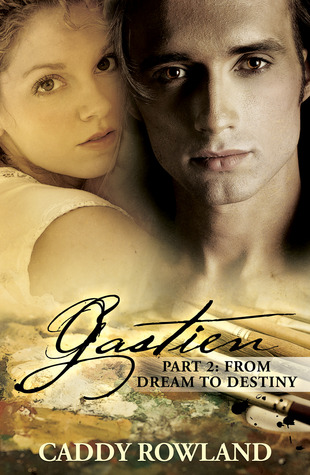
When I started writing The Gastien Series, it really surprised me that more fiction didn’t take place in the Montmartre section of Paris during the late nineteenth and early twentieth centuries. That’s too bad. Few places have been such a haven of creative genius, free thinking, hard drinking, drug taking, sexual freedom, and general debauchery. Those are all things that can be used to make storylines both exciting and interesting.

Montmartre during that time was going through the bohemian art heyday. Impressionism was alive and well, along with many other painting styles that developed after branching off from it. Art would never again be the same. These artists were mostly poor, living in buildings that often housed several, with one well for water and no heat. Starving artist, indeed. Life was tough; making a living was even tougher.

What few people realize is that during that time, Montmartre was also a den of pleasure. Hard drugs were legal and openly sold. At one time there were over 1,500 opium dens legally operating in Paris. Hashish, cocaine, heroin, were all common place. In fact, heroin was advertised in newspapers sold in candy form, and also as a medicine recommended for the whole family!

Let’s not forget the preferred drink of the artists of that time: absinthe. In fact, if you look carefully at some of the paintings done by artists from that era you will find a glass of green liquid somewhere in the painting. For many years we believed the chemical compound thujone was responsible for the brutal effect of the green fairy (as the liquor was called). Now we know that instead it was high alcohol content (90-148 proof)—and the fact that those who sold it to artists and the poor sometimes used rubbing alcohol in it to save money. They figured it was just the poor artists and peasants buying from them, anyway. Talk about class discrimination. No wonder some of those people suffered effects from it. Of course, the wealthy weren’t treated that way.


Drugs and liquor weren’t all one could find, either. Prostitution was rampant (and also legal). Not only could one buy girls, young boys were offered. Many of us are familiar with the Moulin Rouge. It’s respectable now (and has been for decades) but in the beginning? Not quite. There was a huge fake elephant outside that men entered to indulge in opium and whores. The dancers inside the luxurious club did the can-can to advertise their “wares”—many times failing to remember to wear undergarments. Puts a new light on the children’s old rhyme “There’s a place in France where the ladies wear no pants”, doesn’t it?


Yes, Montmartre was the place to be seen and a great many had fun there. Au Lapin Agile, Chat Noir, Moulin de la Galette, Moulin Rouge…all of these were places where the very wealthy traveled to slum it with the bohemian artists and other peasants, if only for the evening. One thing was for sure: not only could those artists paint, they could party. In fact, one evening, Modigliani tore off his clothes and stood on a table in one establishment and yelled “Aren’t I a god?” The women there overwhelming agreed that indeed he was. Suzanne Valadon (one of the few female artists of the time) once slid down a banister at a popular club completely naked—except for a mask.

Au Lapin Agile (The Nimble Rabbit)

And who could blame them for enjoying life when they could? Life was hard. Forgetting for a few hours by altering one’s mind had to be a great temptation, and often times a great blessing. They struggled constantly, but at night they indulged in parties that would make Rome or Las Vegas look like the Pope’s quarters.

Most of the artists that are now famous were part of that scene during different years. Picasso, van Gogh, Modigliani, Renoir, Degas, Matisse, Monet, Cezanne, and many others whose names most of us recognize were all part of the energy that was bohemian Montmartre. If you were an artist who took yourself at all seriously during this era you found a way to eventually get to there.

So many characters, so many vices, so much creativity, and yet so few novels about it. That disappoints me, as I thirst to be brought back to that time since I’m a painter myself. I tip my hat to the few that have used it as their setting for a novel. I also hope you join me in nineteenth century Montmartre yourself by reading The Gastien Series. The first two books of this five book series take place there:

Gastien: The Cost of the Dream Description


When young Gastien Beauchamp flees the farm for Paris, the late nineteenth century bohemian era is in full swing. Color has always called to him, beseeching him to capture it on canvas and show people a new way of seeing things. His father belittled his dream of being an artist and tried to beat him into giving it up. The dream wouldn’t die, but Gastien would have had he not left.

He also yearns to become a great lover. After the years of anguish he has endured at the hand of his father, it would be heaven to feel pleasure instead of pain.

However, the city of Paris has a ruthless agenda. Unless a man has money and connections, Paris unfeelingly crushes dreams and destroys souls. With neither of the required assets, Gastien faces living in alleys, digging in trash bins for food, and sleeping where a man is often killed for his threadbare blanket.

Left with nothing but his dreams, Gastien clings to the hope that the impossible is possible. He pushes on, regardless of the cost.
                                                                                                                                       
Adult fiction for men and women over age 18

Buy link for Gastien: The Cost of the Dream:
http://tinyurl.com/3ecu8ku For Kindle readers or paperback (This book is currently in Amazon Select.)
Sign up for New Release Newsletter by Email: http://eepurl.com/rfjaX
Author Email: caddyauthor@yahoo.com
Twitter: @caddyorpims
Additional books in the Gastien Series:

Amazon


Amazon

Monday, November 11, 2013

Happy Veteran's Day

Today we give thanks and honor all those who've served our country, so that we may be safe.


Thursday, November 7, 2013

What Did A Regency Lady Know? by Ella Quinn

Please join me in welcoming Ella Quinn to the blog today! She's written a great Regency piece for us today. Enjoy!


What Did A Regency Lady Know? 

by Ella Quinn


Most readers who love the genre can come away with a mixed idea of what a lady during the Regency era actually did. Not only books, but movies, and TV as well can give one the impression that they went to parties, shopped, and sat around the house doing needle work. The answer is a bit more complicated.
Most girls were taught, reading, maths, art, literature, at a minimum, French and some Italian. It was more unusual for them to have learned Latin or Greek, which most men studied, but it did happen, and yes, needlework, which amounted to everything from embroidering slippers and handkerchiefs, to the beautiful whitework.

Also pianoforte, and singing. Can you imagine preforming for your future husband and, <groan> mother-in-law?

Jane Austen describes it. “after dinner families and friends were obligated to entertain each other with conversation, musical performances, parlor games and cards, or reading aloud.”

 Let’s not forget horseback riding, and driving a carriage.

However, they also had to have knowledge of how to run a large house and possibly the estate, or estates, as well. Depending on size of her husband’s holdings, that job was the equivalent of running a small to large business.

For an idea on how many servants it took to manage a small place one can look to Georgette Heyer’s Friday’s Child, where the young couple decided to lease a small townhouse, and the number of servants needed to “ensure a moderate degree of comfort” amounted to a cook, butler, two maids, a page boy, groom, tiger, coachman, a lady’s maid, and valet. Since there was no housekeeper, that left the job of directing the maids to the lady of the house. If any of them were ill, it was her job to have the doctor called and pay for the expenses. Not to mention keeping the household accounts.

This was especially true of estates, where it was your responsibility to see to the health and welfare of your dependants, both in the house and tenants who rented plots for farming.

Which leads us to planning social events. There was no buying wine and beer, and throwing out some chips and dip here. Many events had hundreds of guests. If you hosted a house party, that could go on for up to a month, you had to plan the entertainment.

Are you tired yet? Let’s not forget, there is no phone, text or email. In order to keep in touch with family and friends, you have to sit down and write a letter. Unless your husband was a peer and could frank your letters, in which case you could go on for pages, you would make use of one sheet of paper and cross your lines, or even write across again diagonally so that the person receiving your correspondence didn’t have to pay as much. Try reading that.


When does your day end? Generally after dinner, when the men rejoin the ladies and tea has been served.

Available now! The Secret Life of Miss Anna Marsh


“Let yourself be seduced by this sexy mix of spies, smugglers, and happily ever afters.” —Sally MacKenzie
Since she was a young girl, Anna Marsh has dreamed of Sebastian, Baron Rutherford asking for her hand in marriage. But that was in another life when her brother Harry was alive, before she vowed to secretly continue the work he valiantly died for. Now as Sebastian finally courts Anna, she must thwart his advances. Were he to discover her secret, he would never deem her a suitable wife...

Sebastian has always known Anna would become his wife someday. He expects few obstacles, but when she dissuades him at every turn he soon realizes there is much more to this intriguing woman. Somehow he must prove to her that they are meant to be together. But first he must unravel the seductive mystery that is Miss Anna Marsh…


Ella Quinn's studies and other jobs have always been on the serious side. Reading historical romances, especially Regencies, were her escape.

After a stint in the Army, where she was the first woman to be assigned to a Green Beret unit, and serving in Guam and Germany, she decided to return to university where she earned a B.A., and MS in International Relations, and a J.D., which led to another term in the Army as a JAG officer. By day, she works as a family law attorney, helping clients resolve problems, and by night she crafts stories where characters always find happy endings. 

When Ella and her husband to be were dating, he convinced her he was really a Viking warrior. That was thirty-one years ago. They have a son and granddaughter, Great Dane and a Chartreux. After living in the South Pacific, Central America, North Africa and in Europe, she and her husband decided to make St. Thomas, Virgin Islands their home.

           Ella is a member of Romance Writers of America, The Beau Monde, Hearts Through History and is an active member of the Regency Romance Critique Group.

 She’s extensively researched the Regency era both while living in England for two years and aftwards. She imbues her stories with the flavor and feel of the age so that readers lose themselves in the time period. 


Tuesday, November 5, 2013

Video of the Week: Susan B. Anthony Paved the Way for Women's Rights

On this day in history, Susan B. Anthony was arrested for voting in the presidential election in 1872 and fined $100. Her actions as a prominent civil rights activist paved the way for women today. THANK YOU, Susan B. Anthony!

A short video...


Monday, November 4, 2013

A Brief History of the Winter Palace by Ally Broadfield

Welcome to History Undressed, guest blogger, Ally Broadfield! She's written a fabulous piece for us today on The Winter Palace. Enjoy!

A Brief History of the Winter Palace

by Ally Broadfield
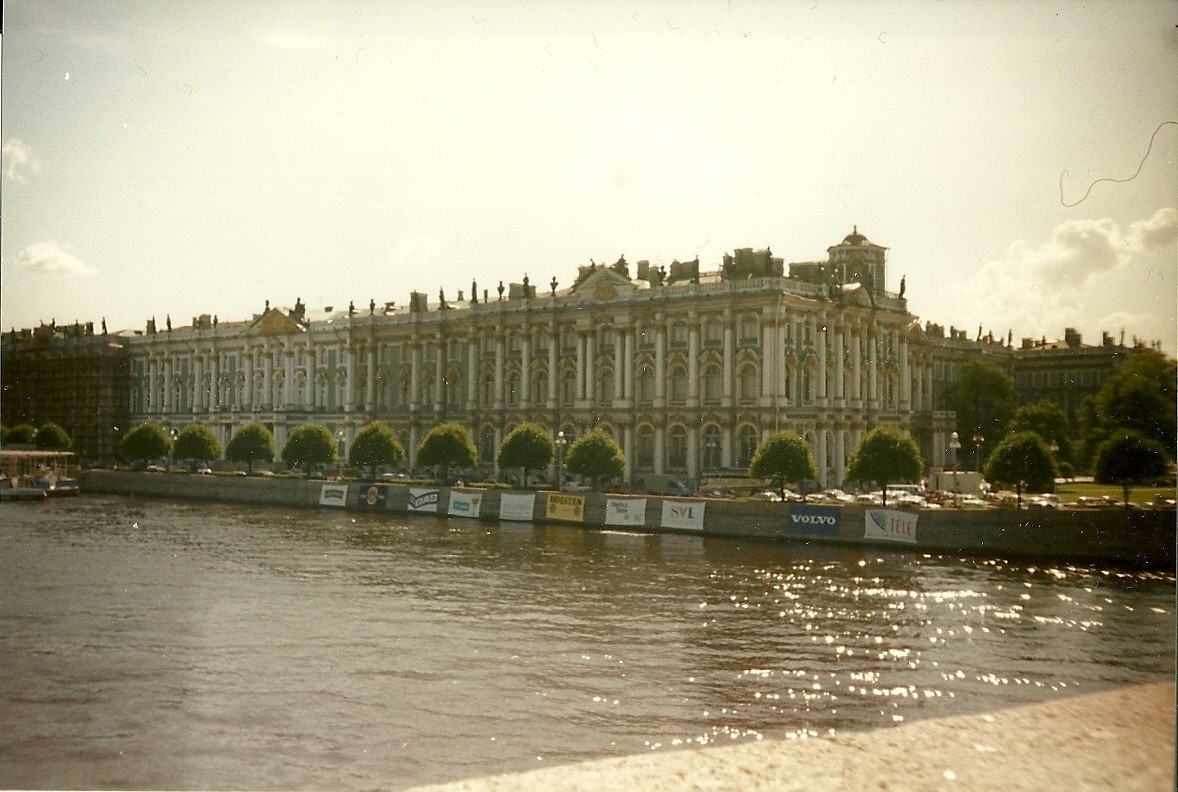
The Winter Palace from the Neva River

Magnificently situated on the bank of the Neva River, the Baroque-style Winter Palace not only served as the main residence of the Russian Tsars, but it has also played a central role in the political and cultural history of St. Petersburg. Today the Winter Palace is known as the main building of the Hermitage Museum. The palace has 1,786 doors, 1,945 windows and 1,057 opulently decorated halls and rooms.

The first Imperial residence on the site of the Winter Palace was a Dutch-style wooden house build for Peter the Great in 1708. In 1711, a stone building replaced the wooden house. The remains of the stone building formed the foundations of the Hermitage Theatre, but parts of it have been restored and are now open to the public. In 1731, Empress Anna Ioannovna commissioned court architect Francesco Bartolomeo Rastrelli to create a new, larger palace on the same site. Completed in 1735, the third Winter Palace survived for only seventeen years before Empress Elizabeth asked Rastrelli to expand the building. After two years of planning, the empress and Rastrelli agreed to a new design that would completely rebuild the palace.

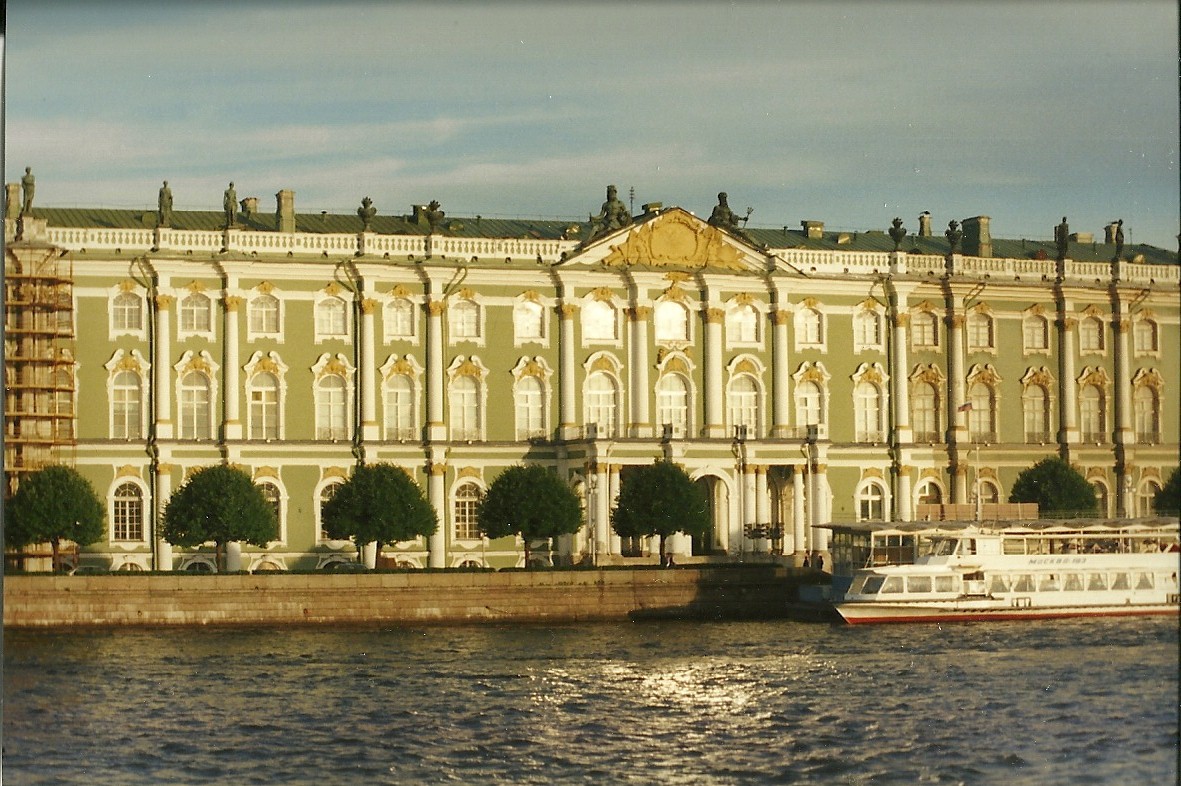
A closer view from a boat on the Neva River


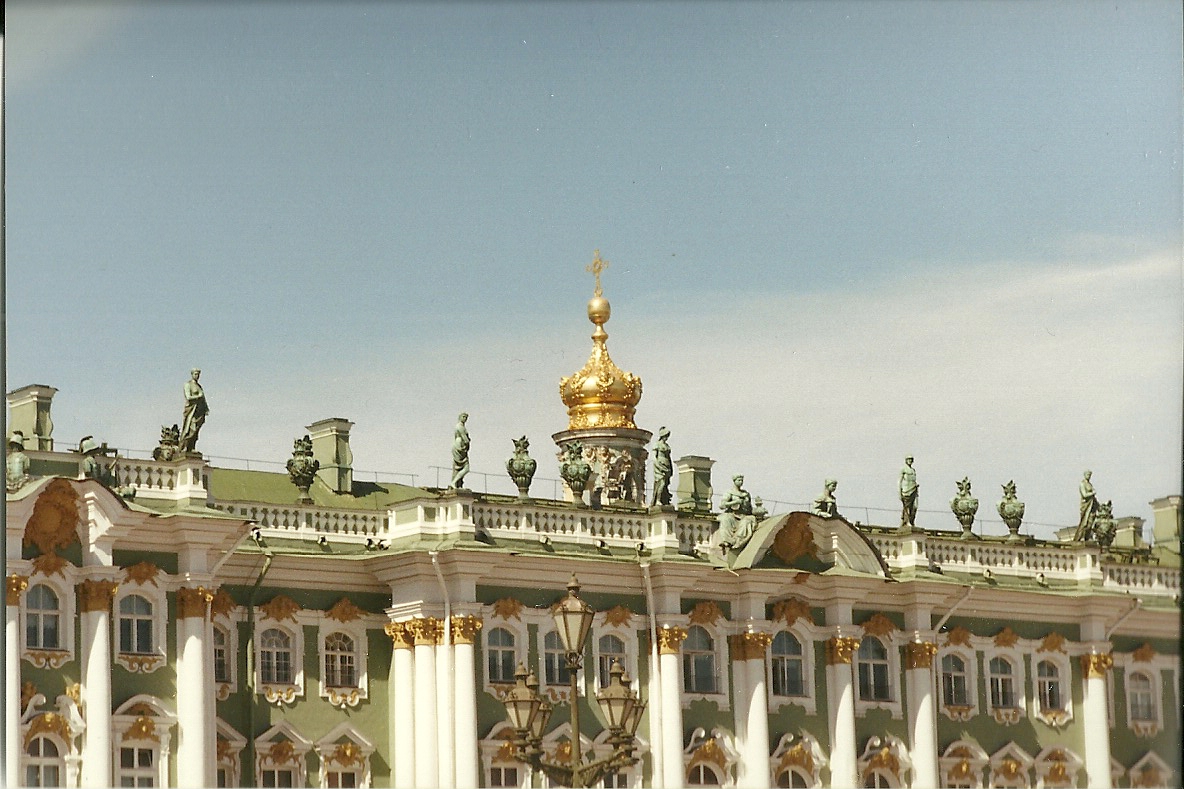
When Catherine the Great took the throne in 1762, the Winter Palace was nearly complete. Though Catherine removed Rastrelli from the project, his designs for the exterior of the palace have remained almost completely unaltered to this day. The building forms a square with an interior courtyard accessed through three archways facing palace square. The lavishly decorated facades feature two levels of ionic columns, and the parapets of the building are decorated with statues and vases. Local regulations prevent any building in the city center from exceeding the palace’s approximately 72 foot height.

The statues and vases decorating the parapets.


Throughout the eighteenth and nineteenth centuries, continual improvements were made to the interior of the palace. In December 1837, a fire destroyed nearly all of the palace’s interior. Nicholas I ordered that the reconstruction of the palace be completed within one year, a monumental task given the technology of the time.

Alexander II was the last of the Tsars to use the Winter Palace as his primary residence. After his assassination in 1881, it became apparent that the palace was too large to be properly secured to ensure the safety of its occupants.  The Winter Palace was still utilized for official ceremonies and receptions. A masked ball commemorating the reign of Tsar Alexey Mikhailovich (the second Romanov Tsar) held in 1903 was the last major event hosted by the Imperial family at the Winter Palace.

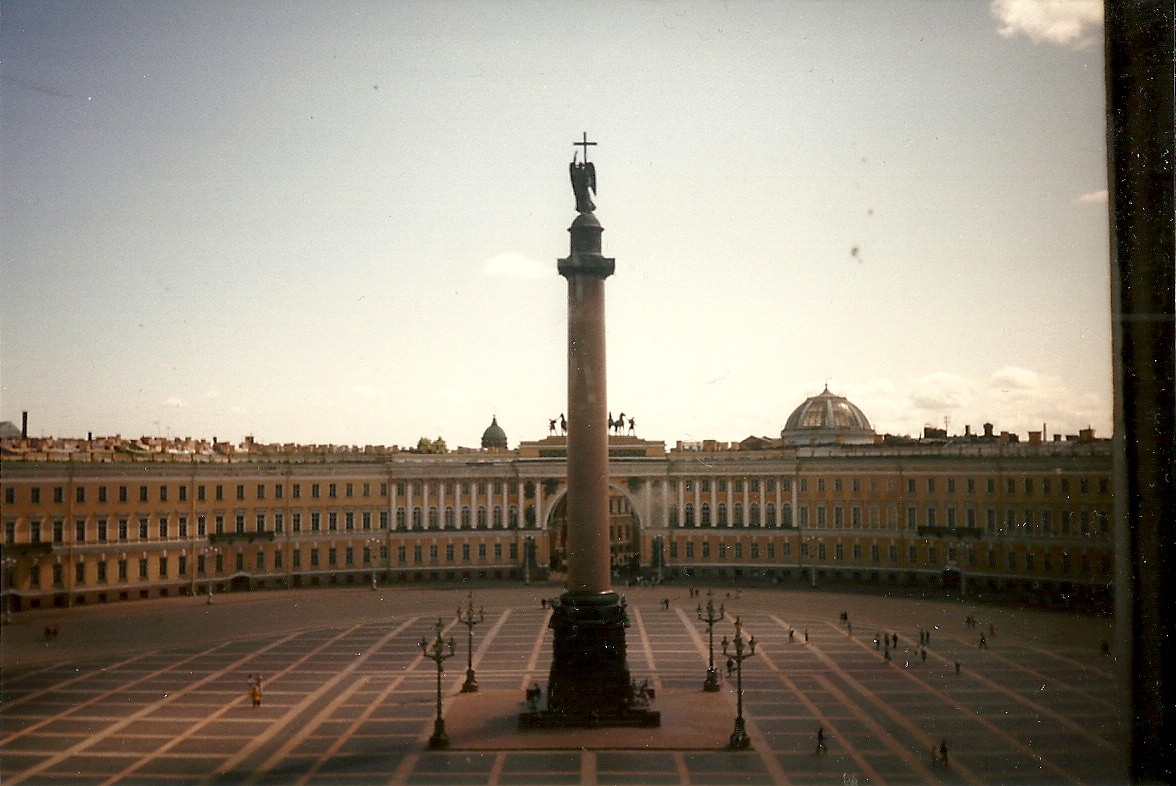
Palace Square from inside the Winter Palace (including the General Staff Building and the Alexander Column commemorating victory over Napoleon).


In 1917, after Nicholas II’s abdication, the Winter Palace became the seat of the Provisional Government under Alexander Krenskiy, and it was against this authority (rather than the Imperial family) that the Bolsheviks stormed the palace.  The Winter Palace was declared part of the State Hermitage Museum on October 17, 1917. Though the Bolsheviks originally instituted a policy to remove all Imperial symbols from the palace, after the siege of Leningrad during World War II, an ongoing process of returning the palace to its Imperial splendor began. The state rooms of the Winter Palace now form one of the most popular sections of the Hermitage.

The interior of the state rooms of the Winter Palace.


For more information, much better pictures than I took, and even a virtual tour, visit the official website of the Hermitage Museum. There is a special section on the Winter Palace Through the Ages.

BIBLIOGRAPHY

Norman, Geraldine. The Hermitage: The Biography of a Great Museum. New York: Fromm International, 1998.

Ally Broadfield lives in Texas and is convinced her house is shrinking, possibly because she shares it with three kids, five dogs, two cats, a rabbit, and several reptiles. Oh, and her husband. She likes to curse in Russian and spends most of her spare time letting dogs in and out of the house and shuttling kids around. She writes historical romance and middle grade/young adult fantasy. Her debut release, Just a Kiss, is coming from Entangled Publishing in December 2013.

You can find Ally on her website, Facebook, and Twitter (though she makes no claims of using any of them properly).